Homeschooling Regulation, Institutional Power, and the Erasure of School-Based Abuse

A survivor-led analysis of safeguarding policy and institutional accountability


This article examines recent proposals to expand state oversight of home education in England, questioning the assumptions that underpin them. Written from lived experience alongside engagement with safeguarding policy and research, it asks why risk is increasingly located in families while abuse within schools remains persistently under-addressed. It is offered as a contribution to public, legal, and ethical debate on what genuine child protection should look like.


Introduction

The government claims that new homeschooling rules are about child safety. We are told they are necessary to protect vulnerable children, to ensure no child is “hidden,” and to give authorities the power to intervene when education or home environments are deemed “unsafe” or “unsuitable.”

But those words — unsafe, unsuitable — are left deliberately vague. And that vagueness matters. When power is expanded without clear limits, it does not fall evenly across society. It falls hardest on those who already live under scrutiny.

This raises a question that policymakers continue to avoid:

If this is really about protecting children, why is there still no serious reckoning with abuse that happens inside schools themselves?


Vagueness as Policy

Under proposed reforms linked to the Children’s Wellbeing and Schools Bill, local authorities may assess not only whether a child is receiving a “suitable education,” but also whether the home environment itself is appropriate.

Yet there is no clear statutory definition of what constitutes “unsafe” or “unsuitable” in this context. Instead, decisions are framed as matters of “professional judgement” (Department for Education, 2024).

Research into child protection decision-making has long shown that discretionary frameworks:

  • increase inconsistency
  • reduce transparency
  • shield institutions from accountability
    (Munro, 2011)

Where statutory thresholds are undefined, accountability is weakened. It becomes difficult to assess whether intervention is necessary, proportionate, or lawful.

Vagueness does not protect children.
It protects the state.


Class, Poverty, and the Judgement of Homes

Once the “home environment” becomes relevant, poverty becomes evidence.

Overcrowding becomes concern.
Stress becomes dysfunction.
Difference becomes risk.

This pattern is well documented. Studies consistently show that families experiencing poverty are far more likely to be investigated for neglect, despite no corresponding increase in actual abuse (Bywaters et al., 2016).

Middle-class families are granted interpretation: alternative, progressive, educationally engaged.
Poorer families are scrutinised: chaotic, concerning, non-compliant.

These are not neutral assessments. They are classed moral judgements embedded in safeguarding systems.


Surveillance, Data, and the Erosion of Private Family Life

Local authorities no longer operate as standalone bodies. They rely on integrated data systems linking:

  • schools
  • social services
  • health services
  • attendance enforcement
  • early help teams

Information circulates across these systems, often without families having full access to or control over what is recorded.

Once a family becomes “known to services,” data is rarely contextualised, corrected, or removed. Concerns accumulate into narratives of risk. These narratives shape future decisions regardless of whether harm was ever substantiated.

This raises serious concerns under Article 8 of the European Convention on Human Rights, which protects the right to private and family life. Interference must be lawful, necessary, and proportionate — standards that are difficult to meet where criteria remain undefined (ECHR, Article 8).

Where criteria remain undefined and data is retained without meaningful challenge, the risk of disproportionate interference increases — particularly for families already known to services.


The Silence Around Abuse in Schools

What is most striking about these reforms is not what they include — but what they omit.

There is no corresponding strengthening of oversight, accountability, or independent reporting mechanisms for abuse that occurs within schools.

This omission persists despite extensive evidence:

  • The Jay Inquiry (2014) documented decades of institutional failure to protect children from sexual abuse in Rotherham.
  • The Everyone’s Invited testimonies (2021) revealed widespread sexual harassment and assault in UK schools.
  • Ofsted has repeatedly acknowledged under-reporting and minimisation of peer-on-peer abuse.

These are not isolated incidents. They reflect systemic patterns of institutional failure.


Survivor Experience Across Time

My concern is not theoretical.

I was abused by a teacher in the late 1980s.
I also had to deal with peer-on-peer abuse incidences in school in the 2000s.

Different decades. Same system. Same responses:

  • minimisation
  • reputational protection
  • containment rather than accountability

Research on institutional abuse shows that survivor disclosures are routinely reframed to protect organisations rather than children (IICSA, 2022). From experience, the full aftermath of abuse within an institution is not meaningfully recognised or accounted for within policy.

Yet policy reform continues to locate risk primarily in families — not institutions.


Who Is Safeguarding the Safeguarders?

Schools largely investigate themselves. Complaints are often handled internally or by bodies structurally dependent on the education system. Children’s disclosures are mediated through professionals whose loyalty may lie with the institution.

This lack of independence limits accountability and allows institutional responses to remain internally controlled.

Families who challenge schools are frequently labelled “difficult” or “uncooperative,” a phenomenon documented in safeguarding literature (Featherstone et al., 2018).

Meanwhile, the state expands its powers over parents.

This asymmetry reveals a core contradiction:
families are policed; institutions are protected.


What This Means for Survivors

For survivors of school-based abuse, these policies are not neutral.

They reinforce the fiction that danger lives primarily in homes.
They retraumatise by trusting the institutions that failed us more than the parents who lived the consequences.
They silence history.

For survivors who later choose to home educate their children, expanded oversight feels punitive rather than protective.

The message is clear:
We trust the system that harmed you more than we trust you.


Conclusion: Safeguarding Requires Accountability

This critique is not anti-safeguarding. It is pro-accountability.

Safeguarding that focuses on surveillance without accountability risks reinforcing the very harms it claims to prevent.

A genuinely child-centred framework would:

  • clearly define intervention thresholds
  • address bias explicitly
  • limit discretionary overreach
  • strengthen independent oversight of schools
  • centre survivor testimony as evidence
  • provide pathways for families who experience abuse in schools and want to re-enter at a later stage

Proposal for trauma centered reintegration

1. Neutral Point of Contact

  • A dedicated LA officer trained in trauma, institutional betrayal, and safeguarding.
  • Initial contact offered in a neutral, non-school-based environment.
  • Written communication as standard to ensure clarity and safety.

2. Trauma-Informed Assessment

  • Assessment of the parent’s previous experiences of harm in school or foster care.
  • Identification of triggers, barriers, and support needs.
  • Recognition that distrust is a logical response to institutional betrayal.

3. Reintegration Planning

  • A personalised reintegration plan co-created with the parent.
  • Clear boundaries around what will and will not be shared with the school.
  • A designated LA liaison to buffer communication between parent and school.

4. School Preparation (Without the Parent Present)

The LA briefs the school on:

  • trauma-informed practice
  • the parent’s communication needs
  • boundaries around disclosure
  • expectations for respectful, non-defensive engagement

The parent is not required to retell traumatic experiences to the school.


5. Supported Introduction to the School

  • First meeting held in a neutral space or with LA presence.
  • The parent is not expected to explain past harm.
  • The LA frames the context in professional, non-personal terms.

6. Ongoing Support

  • Regular check-ins with the LA liaison.
  • Written communication as default.
  • Clear escalation routes if concerns arise.

7. Review & Adjustment

  • The plan is reviewed after 6–12 weeks.
  • Adjustments made based on the parent’s experience and feedback.

8. Accountability & Transparency

The LA maintains responsibility for:

  • safeguarding oversight
  • reintegration support
  • ensuring the school meets its obligations
  • preventing retraumatisation

The burden does not fall on the parent alone, but becomes a shared, transparent approach based on understanding and tailored support.


Until abuse within schools is addressed with the same seriousness as alleged risk within families, safeguarding policy will remain incomplete — and structurally unjust.


References

  • Bywaters, P., et al. (2016). The relationship between poverty, child abuse and neglect: An evidence review. Joseph Rowntree Foundation.
  • Department for Education. (2024). Children’s Wellbeing and Schools Bill (proposed legislation).
  • European Convention on Human Rights. Article 8.
  • Featherstone, B., Gupta, A., Morris, K., & White, S. (2018). Protecting Children: A Social Model. Policy Press.
  • Jay, A. (2014). Independent Inquiry into Child Sexual Exploitation in Rotherham.
  • Munro, E. (2011). The Munro Review of Child Protection. Department for Education.
  • Everyone’s Invited. (2021). Testimonies on sexual abuse in schools.
  • Independent Inquiry into Child Sexual Abuse (IICSA). (2022). Institutional Responses to Child Sexual Abuse.
  • Ofsted. (2021). Review of sexual abuse in schools and colleges.
Posted in societyshiddensecrets | Tagged , , , , , , , , , , , , , , | Leave a comment

Systemic Foster Care Omissions and the Lifelong Barriers They Create

An Analysis Informed by Lived Experience

Introduction

The purpose of this work is to document, analyse, and contextualise experiences within the UK care system from the perspective of someone directly affected by it. By combining personal testimony with existing research on trauma, safeguarding, and institutional accountability, To contribute to a broader understanding of how systemic failures impact survivors across the life course.

This work therefore combines survivor-led qualitative analysis with existing legal, policy, and trauma research to examine how institutional omissions shape long-term outcomes for care-experienced individuals.


Institutional Betrayal

This section explains how failures to record and respond to abuse during childhood can create structural barriers that follow survivors throughout adulthood.

Across the United Kingdom, the foster care system has long operated through procedural frameworks that prioritise documentation, categorisation, and administrative clarity. For children whose experiences were never properly recorded, acknowledged, or acted upon, these same frameworks become barriers in adulthood. What begins as omission in childhood often becomes structural exclusion later in life.

Research on institutional betrayal and systemic neglect demonstrates that failures within protective institutions can compound trauma, creating long-term barriers to healthcare access, justice, and recovery (Smith & Freyd, 2014; Herman, 1992). Evidence from the Independent Inquiry into Child Sexual Abuse (IICSA) and national care-leaver studies shows that failures to record abuse, respond to disclosures, and provide appropriate support have had lasting consequences for survivors across the UK care system (IICSA, 2022; Department for Education, 2021).


Early Omission as a Form of Neglect

Safeguarding systems depend on accurate documentation. When professionals fail to record harm, the omission itself becomes a form of institutional neglect.

Children in foster care rely on professionals to document their needs, experiences, and harms. When this does not happen—whether through oversight, bias, or institutional culture—the consequences are profound. A child who is not believed, not assessed, or not supported becomes an adult without the paper trail that services require to unlock specialist care.

This is not an abstract problem. It is a lived reality for many care-experienced adults who later discover that the system’s failure to act in childhood becomes their burden to carry in adulthood.

Statutory guidance under the Children Act 1989 requires local authorities to safeguard and promote the welfare of children in their care, including maintaining accurate records and responding appropriately to disclosures of harm (HM Government, 2018).

Social services sometimes describe this phenomenon as a child “slipping through the net.”
But when omissions are systemic, repeated, and contrary to safeguarding guidance, a more accurate description is neglect.

In my own case, this failure was formally acknowledged in 2020. Yet acknowledgment alone does not repair the structural damage caused by decades of missing records, unaddressed trauma, and unsupported needs. Presently I still have to navigate a system that relies on proof and documentation, and when the truth has been omitted and replaced with a culture of systemic harm. It creates a systemic gap, across wider government services.


The Administrative Wall: When Services Require Evidence That Was Never Collected

Adult support systems rely heavily on historical records. When those records were never created, survivors encounter structural barriers to care.

Most adult services—whether NHS mental health teams, specialist trauma clinics, disability services, or safeguarding pathways—operate on the assumption that childhood records are complete. They expect to see:

documented injuries
documented disclosures
documented placements
documented concerns
documented interventions

When these records are missing, the system often defaults to:

disbelief
minimisation
confusion
inappropriate referrals
or outright dismissal

The survivor is left attempting to explain a complex life history without the institutional evidence that services require. This is not a personal failing. It is the direct consequence of early omissions by the very agencies responsible for safeguarding the child.

Research into adverse childhood experiences demonstrates that childhood abuse and neglect are strongly associated with long-term physical and mental health consequences, yet these harms are often under-recognised in adult healthcare systems (Felitti et al., 1998; Danese & McEwen, 2012).

Evidence from UK care-leaver research further demonstrates that individuals leaving care experience significantly poorer physical and mental health outcomes compared to the general population, alongside reduced access to stable healthcare support (Department for Education, 2021; The Children’s Society, 2019).


The Fragmentation of Adult Services

When services operate in isolation, survivors are forced to navigate multiple systems simultaneously while still recovering from trauma.

For care-experienced adults, the lack of cohesion between services becomes a second layer of harm. Childhood abuse, medical needs, trauma responses, and legal processes are often treated as separate issues rather than interconnected parts of a single lived experience.

This fragmentation means that an adult survivor may simultaneously be:

supporting police investigations with video-recorded evidence
trying to secure legal representation for a negligence claim
attempting to access specialist trauma therapy
being told by a GP that “nothing is wrong”
being offered basic counselling for circumstances that require specialist trauma treatment
navigating complex systems alone while still processing the original trauma

Complex trauma research emphasises that survivors of prolonged childhood abuse often require integrated, long-term support due to the cumulative psychological and physiological effects of sustained stress (van der Kolk, 2014; Courtois & Ford, 2013).

In effect, the system expects the survivor to function as their own case manager, legal researcher, historian, and advocate—all while recovering from the consequences of systemic neglect.


Access to NHS Services: When the System Cannot See What It Failed to Record

Healthcare systems often rely on documented history to determine eligibility for treatment. When childhood abuse was never recorded, survivors can struggle to access appropriate care.

For many care-experienced adults, the NHS becomes a mirror reflecting the omissions of childhood. When a GP or mental health service reviews a file and sees “nothing documented,” the default assumption is that nothing significant occurred. The absence of evidence becomes evidence of absence.

This leads to predictable outcomes:

survivors are told their symptoms are “mild”
trauma is reframed as anxiety or low mood
referrals are rejected due to “insufficient complexity”
or, paradoxically, “too much complexity”
survivors are directed to short-term counselling that cannot meet their needs

The NHS is not designed to reconstruct a missing childhood.
It is designed to respond to what is already recorded.

For those whose experiences were never documented, the system becomes inaccessible by design.

Studies on institutional betrayal show that when systems fail to acknowledge harm, survivors frequently encounter additional barriers to care and support, reinforcing the original trauma rather than alleviating it (Smith & Freyd, 2014).


Why Private Specialist Therapy Often Becomes the Only Long-Term Option

Where public services cannot meet the needs of complex trauma survivors, private therapy becomes the only consistent pathway to recovery.

Because NHS services are often short-term, overstretched, and bound by strict eligibility criteria, many care-experienced adults find that private specialist therapy becomes the only viable route to meaningful recovery.

Specialist trauma therapy in the UK often costs £80–£150 per session, meaning that weekly therapy can cost £4,000–£8,000 per year or more.

For survivors requiring therapy over many years, the financial burden becomes substantial.

Private therapy offers:

continuity of care
long-term relational stability
specialist trauma expertise & documented records
the ability to work at the survivor’s pace
space to process complex histories without strict time limits

Access to therapy therefore becomes determined not by clinical need but by financial capacity.

For adults whose trauma originated in state care, this represents a profound injustice: the state’s failure in childhood becomes the survivor’s financial burden in adulthood.

In my experience the burden of private therapy though heavy, has the benefit of being able to create the first accurate documentation of ones abuse. Which may help survivors going forward when dealing with the systemic wall often in place without any documentation.


Institutional Accountability and the Economic Cost of Care System Failures

Institutional failures in childhood do not disappear over time; they generate long-term financial costs across healthcare, welfare, and justice systems.

Failures within the foster care system are often discussed in moral or safeguarding terms. Yet they also carry significant long-term economic consequences for the public sector.

Research into adverse childhood experiences demonstrates that early trauma is strongly associated with increased healthcare utilisation, chronic illness, mental health conditions, and reduced economic participation throughout adulthood (Felitti et al., 1998; Danese & McEwen, 2012).

When institutional safeguarding fails, the financial consequences are redistributed rather than resolved.

The cost is transferred:

from the responsible institution
to public healthcare systems
to welfare and social support systems
and to the survivor themselves

Proportionate legal remedy therefore serves not only a moral function but an economic one. When survivors receive compensation that reflects the long-term consequences of institutional failures, it can fund specialist therapy and healthcare that might otherwise fall to the NHS and other public systems.

Where abuse and safeguarding failures occurred within foster placements arranged by the state, questions of institutional responsibility engage both negligence principles and the broader duty of care owed to looked-after children.

Restoring access to legal aid for substantiated cases of abuse in foster care would therefore improve access to justice while also reducing long-term public costs.


Conclusion

Without recognising and addressing the long-term consequences of institutional omission, the foster care system risks perpetuating a cycle in which harm experienced in childhood continues to shape survivors’ health, economic stability, and access to justice throughout their lives.


References

Courtois, C. A., & Ford, J. D. (2013). Treating Complex Traumatic Stress Disorders in Children and Adolescents. Guilford Press.

Danese, A., & McEwen, B. S. (2012). Adverse childhood experiences, allostasis, allostatic load, and age-related disease. Physiology & Behavior, 106(1), 29–39.

Department for Education. (2021). Outcomes for children in need, including children looked after by local authorities.

Felitti, V. J., Anda, R. F., Nordenberg, D., et al. (1998). Relationship of childhood abuse and household dysfunction to many of the leading causes of death in adults. American Journal of Preventive Medicine, 14(4), 245–258.

HM Government. (2018). Working Together to Safeguard Children.

Independent Inquiry into Child Sexual Abuse (IICSA). (2022). Final Report.

Smith, C. P., & Freyd, J. J. (2014). Institutional betrayal. American Psychologist, 69(6), 575–587.

The Children’s Society. (2019). The Cost of Being Care Experienced.

van der Kolk, B. A. (2014). The Body Keeps the Score. Viking.

Posted in societyshiddensecrets | Tagged , , , , , , , , , , , , , | Leave a comment

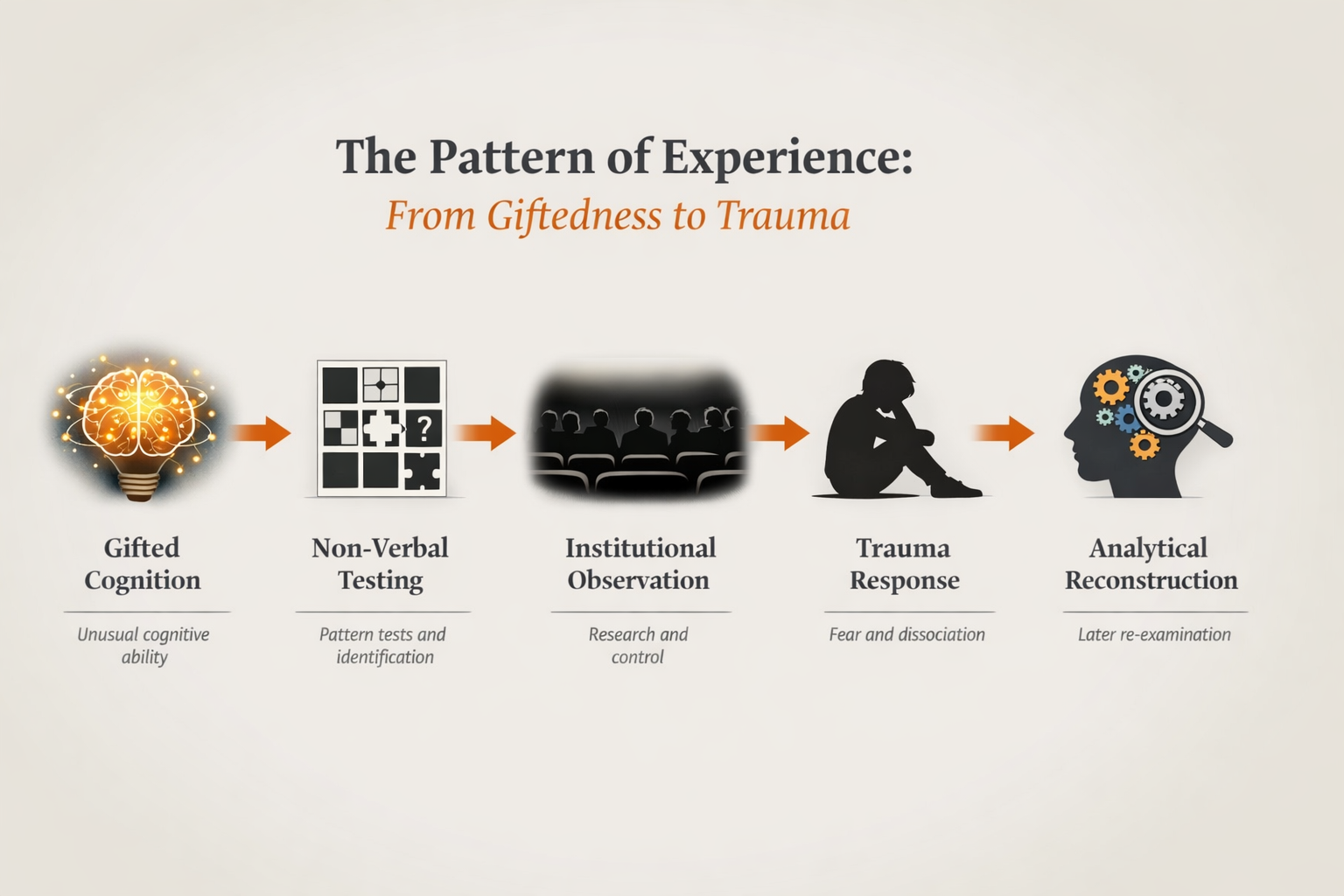
When Gifted Children Became Subjects

Non-Verbal Testing, Hypnosis, and the Experience of Being Studied

Institutional Context: Bristol in the 1980s

During the 1970s and 1980s, research into children’s cognition expanded significantly across the United Kingdom. Educational psychologists, universities, and schools increasingly explored non-verbal intelligence, spatial reasoning, and gifted cognition, particularly among children who demonstrated unusual pattern recognition or problem-solving ability (Raven, Raven & Court, 1998; Silverman, 2002).

In cities with major universities and teaching hospitals, these interests often intersected with local professional networks. In Bristol, institutions existed within a wider professional environment that included educators, educational psychologists, medical practitioners, and social services professionals. Within these networks, research into child development and cognition formed part of a broader culture of professional collaboration.

The culture of institutional authority in Bristol during this period was later examined by the Bristol Royal Infirmary Inquiry (Kennedy Report). Although the inquiry focused on failures in paediatric cardiac surgery, it revealed deeper systemic problems including professional hierarchies, limited challenge between disciplines, and systems in which the voices of children and families were not always given sufficient weight.

The inquiry emphasised a central principle that applies far beyond medicine: the welfare of children must come before institutional priorities or professional authority.


Non-Verbal Testing and the Identification of Gifted Children

During the mid-twentieth century and continuing into the 1980s, educational psychologists increasingly used non-verbal reasoning tests to identify children with high intellectual potential.

One of the most widely used examples was Raven’s Progressive Matrices, which involved black-and-white pattern cards where children identified the missing element in a visual sequence (Raven, Raven & Court, 1998).

Because these tests relied on pattern recognition rather than language, they were often used to identify reasoning ability across diverse populations.

Children who performed strongly on such tasks frequently demonstrated cognitive characteristics including:

  • holistic perception of problems
  • rapid pattern recognition
  • strong visual-spatial reasoning
  • the ability to mentally simulate systems or structures

(Silverman, 2002).

However, identification through testing did not always lead to meaningful educational support. In some cases, particularly for minority children, those identified as cognitively unusual became subjects of observation rather than beneficiaries of enrichment.


Access to Children in Institutional Care

Historically, children living within institutional systems—including residential care or foster placements—were sometimes easier for professionals and researchers to access than children living within stable family environments.

Institutional structures allowed professionals to authorise access administratively. Decisions about participation could be made by institutions responsible for a child’s care rather than by parents or guardians acting independently.

For children who entered foster care from an early age, this created a particular vulnerability. Without a consistent advocate, decisions about assessments, testing, or participation in activities could be made by professionals acting on behalf of the child, often without the child’s consent or even an explanation.

Historians of research ethics have shown that vulnerable populations have often been disproportionately represented in institutional studies because they were easier for organisations to access (Sköld, 2013).

Within this environment, educational psychology sometimes functioned as a gateway into wider observational settings. Children identified through non-verbal testing could be referred into demonstrations, programmes, or assessments shaped by broader psychological research trends.


Being Identified Through Non-Verbal Testing

As a child in school in Bristol, I was identified through non-verbal reasoning exercises involving black-and-white pattern cards similar to Raven’s matrices testing.

At the time I had already been within the foster care system since around the age of four or five.

The exercises appeared to focus on visual pattern recognition and problem-solving ability. However, I was never told that these activities related to giftedness or cognitive assessment.

Instead, I experienced being singled out and removed from normal classroom activities.

By the age of eleven, teachers had already recognised strong analytical ability and problem-solving skills.

Yet by the age of twelve I was removed from mainstream school entirely.

While other children continued through normal education, my schooling was disrupted and my cognitive abilities were never explained or supported.


Hypnosis, Suggestion, and Dissociation Research

During the 1970s and 1980s, hypnosis and suggestion were widely studied within psychology and psychiatry. Researchers explored how suggestion could influence perception, behaviour, and memory, often examining the concept of dissociation—the idea that aspects of conscious awareness could temporarily separate from voluntary control (Hilgard, 1977).

These developments were part of a wider national research landscape in which psychology, medicine, education, and human-factors research frequently overlapped. Across the UK, studies examined attention, perception, stress responses, dissociation, suggestibility, and the effects of sensory environments on human behaviour (Hilgard, 1977; Warm, Parasuraman & Matthews, 2008). During the Cold War period, psychological research into human performance and cognition was also linked to broader national interests in understanding stress, vigilance, and decision-making under pressure (McCauley, 2022). Methods developed in one domain—such as controlled lighting environments, suggestion-based tasks, and observational settings—sometimes appeared in others without being formally labelled as research.

Psychologists examined how individuals responded to hypnotic suggestion and altered states of awareness.

Experiments often involved demonstrations in which suggestion influenced behaviour, such as the well-known exercise where participants were told they would become “stuck” to a chair.

Although such work was usually conducted with adult volunteers in controlled laboratory settings, demonstrations of hypnosis also appeared in public and educational contexts. Research into attention and perception also explored how environmental conditions—including lighting, observation, and sensory stimuli—could influence behaviour and cognition (Warm, Parasuraman & Matthews, 2008).

In those environments the boundary between psychological assessments, research, demonstration, and entertainment could sometimes become unclear.


Highly Responsive or “Virtuoso” Subjects in Hypnosis Research

Research into hypnosis has long recognised that responsiveness to suggestion varies widely across individuals. Within the literature, a small proportion of participants are described as highly hypnotisable or high-susceptible subjects, meaning they demonstrate a stronger ability to respond to suggestion, altered perception, or temporary changes in voluntary control (Hilgard, 1977; Kirsch et al., 1999).

In some discussions within hypnosis research, particularly in informal descriptions of experimental participants, such individuals have occasionally been referred to as “virtuoso” subjects—a term used to describe participants who appear able to enter and maintain hypnotic states more readily than most of the population.

Psychological studies of hypnosis in the United Kingdom explored how these highly responsive participants engaged with suggestion, imagery, and altered states of attention. Work by researchers including Peter Naish examined the cognitive processes involved in hypnotic responsiveness, including the role of focused attention, mental imagery, and dissociation (Naish, 1999).

Within this field, responsiveness to suggestion was not interpreted as weakness or passivity. On the contrary, research often associated high responsiveness with strong imaginative capacity and the ability to engage deeply with internally generated imagery. These traits can overlap with cognitive styles characterised by vivid spatial imagination and the ability to construct complex mental representations.

Participants who demonstrated unusually high responsiveness were therefore of particular interest within hypnosis research because they allowed researchers to explore how suggestion could influence perception, memory, and voluntary control under controlled conditions.

The Theatre Session

One experience remains particularly vivid.

I was taken to a theatre where around ten children were seated on chairs on the stage itself. The chairs were arranged so that we faced outward toward the auditorium. I was the only child of colour there.

In front of us were rows of audience seats. But the entire auditorium was in complete darkness.

The theatre lights were switched off everywhere except the stage. Bright lights illuminated the hypnotist and the children seated on the stage, while the audience seating disappeared into pitch blackness.

I was seated to the far right, and everyone else was seated to my left. From where we sat the theatre appeared empty.

Only later did I understand that observers were likely somewhere watching.

At the time the experience felt like sitting exposed on a stage in front of an invisible audience.

The hypnotist performed demonstrations designed to influence perception and bodily control. One exercise involved the suggestion that participants would become “stuck” to their chairs.

For some children the event may have appeared entertaining.

For me it was terrifying.

As a child who was largely selectively non verbal, I enjoyed just absorbing the environmental detail with my senses. When those senses were taken away it was highly traumatic.


Distress and Dismissal

The environment created intense disorientation.

We were seated under bright stage lights while the entire audience area remained in complete darkness. Anyone watching us remained unseen.

Under these conditions I became visibly distressed, crying and showing clear signs of fear and overwhelm. I knew the hypnotist was responsible because he told me to try to stand up. At the time, I did not understand that I was experiencing hypnotic paralysis.

A female observer came from a door at the back far right from within the darkness of the seating area and I remember her kneeling in front of me speaking, while the hypnotist stood slightly back.

It was not fun to me.

The experience felt frightening and violating, which was extremely destabilising for a child already within the foster care system.

Instead of recognising harm, the situation reframed my distress as though I simply failed to understand the entertainment, being difficult, not complying with requests — it made me the problem.

In that moment, the reality of my own observation and the excitement of the observer existed side by side in complete contradiction. The difference is that my memory stored a three-dimensional reconstruction that I can still visualise, allowing me to collate my own observations about the event.


Trauma, Authority, and Survival Responses

Experiences like this can shape how a child responds to authority.

Being forced to remain in a situation despite visible distress can reinforce survival responses such as:

  • fear of authority
  • compliance under pressure
  • dissociation as a coping mechanism

For children already living within unstable environments, these responses can become deeply embedded (Perry & Szalavitz, 2017).


Gifted Cognition and Three-Dimensional Memory

One of the most striking paradoxes of this experience is that the same cognitive abilities that attracted attention, later became tools for mapping the experience itself.

My thinking is strongly visual and spatial. Memories often exist as three-dimensional reconstructions rather than simple narratives.

In this sense, the same cognitive architecture that once made my mind interesting to study later allowed me to analyse my life experience itself with unusual clarity.


Institutional Culture and Responsibility

Looking back, several elements form a pattern.

Non-verbal testing identified unusual cognitive ability.
The child involved had already been living in foster care from an early age.
Professional networks connected schools, psychologists, and institutions.
And decisions about participation were made without explanation to the child involved.

The findings of the Bristol Royal Infirmary Inquiry (Kennedy Report) emphasised that institutional culture can allow professional authority to override the experiences of those most affected.

Although the inquiry focused on medical practice, its lessons apply more widely, including research environments that drew on medical or psychological methods.

When children are identified as cognitively exceptional but denied educational support, their abilities can become shaped by the environments they must navigate rather than by opportunities to develop them. Children living within institutional systems require greater protection and transparency, not less.

It is not possible to determine the precise purpose of every activity that took place in educational or observational settings during this period. Institutional records rarely capture the full experience of the children involved, and many events described by participants were not formally documented. The account presented here therefore does not attempt to assign responsibility for specific actions. Instead, it situates lived experience within the broader historical context of psychological research practices, educational assessment, and institutional decision-making in the United Kingdom during the late twentieth century.

Foster children are not research material. They are individuals whose welfare, autonomy, and development must come before institutional curiosity and the advancement of theory.

In this way, the child who was once observed becomes the one able to observe the system that surrounded them.


References

Hilgard, E. R. (1977). Divided Consciousness: Multiple Controls in Human Thought and Action. Wiley.

Kirsch, I., Capafons, A., Cardeña, E., & Amigó, S. (1999). Clinical Hypnosis and Self-Regulation: Cognitive-Behavioral Perspectives. American Psychological Association.

McCauley, M. (2022). A Century of Military Psychology in Britain and Ireland.

Naish, P. (1999). Hypnosis and Cognitive Processes. Contemporary Hypnosis, 16(3), 129–135.

Perry, B. D., & Szalavitz, M. (2017). The Boy Who Was Raised as a Dog. Basic Books.

Raven, J., Raven, J. C., & Court, J. H. (1998). Manual for Raven’s Progressive Matrices. Oxford Psychologists Press.

Silverman, L. K. (2002). Upside-Down Brilliance: The Visual-Spatial Learner. DeLeon Publishing.

Sköld, J. (2013). Historical perspectives on child abuse and neglect research. Journal of the History of Childhood and Youth.

Warm, J. S., Parasuraman, R., & Matthews, G. (2008). Vigilance Requires Hard Mental Work and Is Stressful. Human Factors.

Posted in societyshiddensecrets | Tagged , , , , , , , , , , , , , | Leave a comment

How Race Shapes Systemic Responses to Abuse in Foster Care:

An Analysis Informed by Lived Experience in the 1980s and 1990s

Introduction

Entering foster care as a mixed race child meant entering a system already structured by racialised assumptions about vulnerability, behaviour, and credibility. From the outset, I was placed in environments where racist language was normalised by peers and minimised by adults. Teachers framed racist bullying as “chip on my shoulder,” and foster carer’s failed to intervene. These early experiences reflect how institutions position children of colour as other, less vulnerable, and less entitled to protection.

In social-science terms, this process is known as racialisation — the assignment of meaning, value, and risk based on perceived race (Omi & Winant, 2015). For children in care during the late twentish century, racialisation shaped every interaction with professionals and systems.


Adultification and the Erosion of Childhood Innocence

Adultification bias describes the tendency to perceive Black and biracial children as older, more knowledgeable, and less innocent than their white peers (Epstein, Blake & González, 2017). Research has shown that Black children are often viewed as more culpable and less deserving of protection, even at very young ages.

In my case, this bias was evident by the age of nine, when my behaviour had become sexualised — an indicator that should have triggered safeguarding intervention. Instead, professionals interpreted my behaviour through a racialised lens that minimised vulnerability and reframed abuse indicators as signs of agency. As a result, I was increasingly perceived as the problem, while the abuser remained freely present within a frequently rotated short-term placement environment.

When I used slang such as “baby mum,” language absorbed from older children I was placed with, it was recorded in files as evidence of adult sexual knowledge. The critical safeguarding question — “Does this child understand consent?” — was never asked. At that time, I did not know what consent meant. I had come to see abuse as something that happened to women and girls – something I was expected to accept. If I resisted or spoke about it, I believed I would be seen as the problem – which had happened when I disclosed at age 10.

This internalisation was itself a consequence of adultification. My attempts to make sense of what was happening to me were interpreted as evidence of maturity rather than indicators of harm.

In later years, these same interpretations were used to undermine my credibility and to diminish empathy for the fact that the institution itself later admitted indictors of harm were present, but failed to act under its safeguarding duties.

Adultification bias therefore functioned as a barrier to protection. Indicators of abuse were reframed as indicators of maturity or culpability, allowing the system to shift attention away from the perpetrator and onto the child.


Placement Practices and the Construction of Risk

Children of colour in care are disproportionately placed in environments with older or more vulnerable young people. This reflects institutional assumptions that they are more resilient or “streetwise,” and therefore less in need of protective placement.

These placements expose younger children to sexualised behaviour, grooming, violence, and coercion. In my own experience, the language and behaviours I absorbed from older children were later interpreted as intrinsic to me, rather than as a consequence of the environment into which I had been placed.

This illustrates how systemic decisions create the very risks later attributed to the child.


Case Files as Instruments of Racialised Narrative Construction

Professional records in social care are often treated as objective truth, yet they are often shaped by the biases, assumptions, and omissions of those who write them. For children of colour, files frequently contain:

  • racialised interpretations of behaviour
  • adult sexual themes applied to children
  • character judgements rather than contextual analysis
  • omissions of racism, abuse, or neglect.

These narratives become institutional memory. They influence how police, social workers, teachers, and legal professionals interpret the child’s credibility and vulnerability for years.

In my case, the local authority later upheld findings that they knew I was being abused and failed to act over a period of years. Yet the files written about me contained racialised interpretations that obscured the harm and reinforced a narrative of agency rather than victimisation.

Institutional records therefore function not only as documentation, but as mechanisms through which institutional narratives are constructed and reproduced (Smith, 2005).


Selective Safeguarding and Differential Responses to Risk

A striking example of bias in my own history is that although I was identified as being at risk, I was not interviewed. The other child involved — who was from a different cultural background — was prioritised. My welfare was not considered central to the investigation taking place at the time.

This reflects a broader pattern in which children of colour are:

  • less likely to be believed
  • less likely to be interviewed
  • less likely to receive therapeutic support
  • more likely to be blamed or problematised.

This pattern has been documented across safeguarding systems, where racialised assumptions influence professional assessments of risk and credibility (Bernard & Gupta, 2008).

This is not an individual failure; it is a structural one. It demonstrates how institutional responses are stratified by race, determining who is seen as a victim and who is not.


Structural Racism Across the Safeguarding and Justice Continuum

Racism in care is not limited to interpersonal prejudice. It is embedded in the structures and routines of the system. It manifests in:

  • placement decisions
  • risk assessments
  • professional language
  • investigative priorities
  • access to therapeutic support
  • police responses
  • legal representation.

When professionals across multiple agencies hold implicit or explicit biases, the cumulative effect is a system that consistently provides lower levels of protection to children of colour.

This continues into adulthood. When survivors report abuse, the same biases reappear: police rely on racialised files, investigators minimise disclosures, legal professionals assess cases through a cost-risk lens that disadvantages victims of colour, and institutions prioritise reputational protection over accountability.

The result is a justice gap in which victims of colour are the least likely to receive proportionate redress.


Generational Impacts and the Long-Term Consequences of Systemic Failure

The consequences of these systemic failures do not end with the individual child. When institutions consistently fail to protect children of colour, the effects become intergenerational.

This occurs through:

  • disrupted educational and developmental pathways
  • trauma responses affecting relationships and stability
  • reduced access to justice and reparative support
  • structural gatekeeping that limits social mobility
  • cumulative disadvantage that compounds across generations.

These impacts are often invisible in policy discussions because they do not appear as single events; they accumulate over time.

When children of colour are believed less, protected less, and offered fewer pathways to recovery, the result is a form of systemic hindrance that restricts progress within families and communities.


The Role of Testimony in Challenging Institutional Narratives

My testimony is not an alternative to official records; it is a necessary addition to them – filling in gaps.

Lived experience provides insight into mechanisms that institutions fail to record or actively obscure. Survivor testimony:

  • exposes systemic patterns
  • contextualises behaviours misinterpreted by professionals
  • challenges narratives
  • contributes qualitative data for research and advocacy.

By documenting these mechanisms, testimony contributes to a broader understanding of how race interacts with care systems and how institutional responses can perpetuate harm rather than prevent it.


References

Bernard, C., & Gupta, A. (2008). Black African children and the child protection system. Child Abuse Review, 17(6), 476-489.

Epstein, R., Blake, J., & González, T. (2017). Girlhood Interrupted: The Erasure of Black Girls’ Childhood. Georgetown Law Center on Poverty and Inequality.

Felitti, V. J., Anda, R. F., Nordenberg, D., et al. (1998). Relationship of childhood abuse and household dysfunction to many of the leading causes of death in adults. American Journal of Preventive Medicine, 14(4), 245–258.

Omi, M., & Winant, H. (2015). Racial Formation in the United States. Routledge.

Smith, D. E. (2005). Institutional Ethnography: A Sociology for People. AltaMira Press.

Posted in societyshiddensecrets | Tagged , , , , , , , , | Leave a comment

Gifted Cognition in Adverse Environments: Systems Thinking, Trauma, and Misrecognition in Foster Care

Recognising Diverse Forms of Giftedness

The following section explains how my cognitive style developed within the context of foster care and trauma, and why forms of giftedness that do not follow traditional educational pathways are often overlooked among children in care.

Giftedness is typically defined and identified through academic performance, standardised testing, or formal educational pathways. However, these frameworks often fail to recognise forms of cognitive ability that develop outside conventional schooling, particularly among children experiencing instability within care systems. Research indicates that gifted cognition can manifest through visual–spatial reasoning, systems thinking, and integrative problem solving that may not be captured through traditional academic assessment (Silverman, 2002; Rinn & Bishop, 2015).

Early Recognition and Educational Disruption

My own experience illustrates how such cognitive traits can emerge and adapt within adverse environments. By the age of eleven, teachers had already recognised strong analytical ability and advanced problem-solving skills within the school environment. However, my educational trajectory was abruptly interrupted when I was removed from school by the age of twelve. From that point onward I received no further formal education during childhood while living within foster care placements characterised by instability and abuse.

This disruption fundamentally altered how my cognitive abilities developed. Without structured schooling, learning became self-directed and internally modelled. Rather than progressing through sequential educational instruction, I relied heavily on visual–spatial reasoning and systems-based analysis to understand the world around me.

Visual–Spatial Reasoning and Three-Dimensional Modelling

A defining feature of this cognitive style is the ability to mentally construct three-dimensional representations of systems before acting upon them. Problems are often perceived holistically, with the completed structure visualised internally before the steps required to achieve it are consciously articulated. Visual–spatial learners frequently describe this as “seeing the whole first,” a process in which the overall structure becomes clear before the sequence of actions required to construct it (Silverman, 2002).

In practice, information is rarely processed linearly. Instead, multiple layers of information—environmental cues, behavioural patterns, institutional rules, and potential outcomes—are integrated rapidly into an internal model. The mind effectively performs a form of internal systems simulation, allowing both the whole structure and its individual components to be understood simultaneously.

Systems Thinking and Rapid Information Integration

Research on systems thinking similarly identifies the capacity to perceive relationships across complex environments as a form of advanced reasoning (Senge, 2006). Individuals with strong systems cognition are able to recognise patterns across domains, identifying how changes in one part of a system influence the behaviour of the whole. Because this reasoning often occurs internally through modelling rather than step-by-step verbal explanation, it may not always be visible to others.

Trauma, Hyper-Awareness, and Cognitive Adaptation

When such cognitive abilities develop within environments characterised by abuse, instability, or institutional oversight, they may be redirected toward survival rather than intellectual exploration. Trauma research demonstrates that children exposed to chronic adversity often develop heightened sensitivity to environmental patterns and behavioural cues in order to anticipate potential threat (Perry & Szalavitz, 2017). For children with strong pattern recognition and integrative reasoning, this heightened awareness can amplify the tendency to analyse social and institutional dynamics.

In these circumstances, abilities associated with gifted cognition—rapid information integration, pattern recognition, and systems modelling—can become intertwined with vigilance. Rather than being directed toward academic development, the child’s analytical capacity may be used to navigate complex social and institutional environments. The same cognitive architecture that might support advanced academic reasoning instead becomes a tool for interpreting instability, predicting adult behaviour, and recognising contradictions within authority structures.

Misrecognition of Giftedness in Care Systems

Because this reasoning is largely internal and visually modelled, it is rarely recognised by institutions responsible for children in care. Instead of being identified as intellectual strength, these analytical tendencies may be misinterpreted as behavioural intensity, emotional sensitivity, or over-analysis. Gifted cognition that does not present through conventional academic performance is therefore frequently overlooked (Rinn & Bishop, 2015).

Despite receiving no formal education after the age of twelve, the cognitive architecture that developed through these circumstances later enabled me to pursue higher education independently. Through visual modelling, pattern recognition, and integrative reasoning, I was able to construct conceptual frameworks for complex academic material and ultimately obtain a university degree. In this sense, the same cognitive style that developed as a survival mechanism within unstable systems later became a pathway to academic achievement.

Educational Inequality in Foster Care

However, this trajectory reflects individual adaptation rather than systemic support. Children in care experience significantly poorer educational outcomes compared to their peers, with far fewer progressing to higher education (Sebba et al., 2015). Within this population there are undoubtedly children with significant intellectual potential whose abilities remain unrecognised due to instability, trauma, and systemic neglect.

Racialisation, Adultification, and the Misinterpretation of Ability

The misrecognition of gifted cognition among children in care also intersects with broader dynamics of racialisation and adultification bias. Research shows that children of colour, particularly Black and mixed-race children, are more likely to be perceived as older, more responsible, and less in need of protection than their peers (Epstein, Blake, & González, 2017). Within institutional environments such as foster care and schools, this bias can distort how behaviour and ability are interpreted.

For children who demonstrate strong analytical or systems-oriented thinking, adultification can lead to cognitive maturity being reframed as defiance, overconfidence, or behavioural difficulty rather than intellectual capability. In this way, racialised assumptions can intersect with institutional instability to further obscure intellectual strengths.

Implications for Recognition and Support

Understanding how gifted cognition interacts with trauma and systemic bias is therefore essential. When visual–spatial reasoning and systems thinking develop within unstable environments, they may function both as survival strategies and as indicators of significant intellectual capacity. Recognising and supporting these forms of giftedness could allow many children in care to develop their potential more fully, rather than having their cognitive abilities shaped primarily by the demands of navigating unstable systems.

Institutional Responsibility

Where such abilities remain unrecognised, the consequences extend beyond missed educational opportunity. The failure to identify and support diverse forms of intellectual ability among children in care reflects a broader pattern of institutional neglect, in which children’s developmental needs are subordinated to administrative management of placements and behaviour. In these contexts, cognitive strengths may be redirected toward navigating systemic instability rather than being nurtured through education and support. Recognising how gifted cognition can coexist with trauma exposure is therefore not only an educational concern but also a matter of institutional responsibility. When systems charged with safeguarding children fail to recognise and respond to developmental needs—including intellectual potential—questions of accountability inevitably arise.

References

Epstein, R., Blake, J. J., & González, T. (2017). Girlhood interrupted: The erasure of Black girls’ childhood. Georgetown Law Center on Poverty and Inequality.

Perry, B. D., & Szalavitz, M. (2017). The boy who was raised as a dog: What traumatized children can teach us about loss, love, and healing (3rd ed.). Basic Books.

Rinn, A. N., & Bishop, J. (2015). Gifted adults: A systematic review and analysis of the literature. Gifted Child Quarterly, 59(4), 213–235. https://doi.org/10.1177/0016986215600795

Sebba, J., Berridge, D., Luke, N., Fletcher, J., Bell, K., Strand, S., Thomas, S., Sinclair, I., & O’Higgins, A. (2015). The educational progress of looked-after children in England: Linking care and educational data. University of Oxford, Rees Centre for Research in Fostering and Education.

Senge, P. M. (2006). The fifth discipline: The art and practice of the learning organization (Revised ed.). Doubleday.

Silverman, L. K. (2002). Upside-down brilliance: The visual-spatial learner. DeLeon Publishing.

Posted in societyshiddensecrets | Tagged , , , , , , , , , | Leave a comment

Institutional Accountability and Legal Responsibility

Institutional Accountability, Embodied Trauma, and Pathways to Justice

This article discusses the longer-term impacts of institutional betrayal, substantiated abuse, its physiological consequences, and the pathways to justice from a lived perspective – referencing my own ethnographic experience, and substantiated statutory sexual abuse.

The physical consequences of complex post-traumatic stress disorder (CPTSD), early menopause, and chronic stress are not personal failings. They are foreseeable outcomes of prolonged exposure to abuse and neglect — particularly when that abuse occurs within state or corporate care.

Under English negligence law, liability turns on foreseeability, breach of duty, and causation (Caparo Industries plc v Dickman [1990] 2 AC 605). Where abuse occurs within foster placements arranged by local authorities, the Supreme Court has confirmed that councils may be vicariously liable for the acts of foster carers (Armes v Nottinghamshire County Council [2017] UKSC 60). The Court has also recognised that certain duties owed to vulnerable individuals are non-delegable (Woodland v Essex County Council [2013] UKSC 66).


Clarifying the Limits of the Poole Decision

It is also important to distinguish these duties from the Supreme Court’s decision in CN and GN v Poole Borough Council [2019] UKSC 25. In that case, the Court held that local authorities do not automatically owe a common-law duty of care to protect children from harm simply by exercising statutory safeguarding functions under the Children Act 1989. However, the judgment specifically concerned children who were not taken into care and whose relationship with the authority did not go beyond the general statutory framework.

The Court reaffirmed that a duty of care may arise where a local authority assumes responsibility for a child or where a special relationship exists, such as where the child is formally placed in care or otherwise under the authority’s control. This distinction is crucial. Where children are subject to court-ordered care arrangements, foster placements, or other forms of statutory guardianship, the legal relationship between the child and the authority is fundamentally different.

In such circumstances, the authority may still be liable in negligence, including through vicarious liability for foster carers, as recognised in Armes v Nottinghamshire County Council, or through non-delegable duties owed to vulnerable individuals, as recognised in Woodland v Essex County Council.

Understanding this distinction matters. Survivors whose childhoods were governed by court orders, foster placements, or statutory parental responsibility exercised by the state should not assume that the Poole decision prevents civil claims. The legal duties owed to children formally in care remain significantly stronger than those owed in general safeguarding contexts.

Substantiated failures to intervene, failures to investigate disclosures, and failures to provide protective care constitute breaches of duty with long-tail consequences. – should have clear accessible pathways available.


Legal Accountability, Evidentiary Gaps, and the Cost of Institutional Denial

When the body becomes the evidence, the law often looks for simplicity. Legal systems tend to prioritise discrete, easily provable injuries over cumulative harm. Yet complex trauma reorganises the body over time, altering stress systems, immune function, and metabolic regulation (Herman, 1992; van der Kolk, 2014; McEwen, 2007).

Limitation law presents further barriers. Under the Limitation Act 1980, abuse claims may be time-barred unless courts exercise discretion under section 33. The House of Lords in A v Hoare [2008] UKHL 6 acknowledged that sexual abuse may justify disapplication of limitation periods where psychological harm delayed disclosure.

An accumulative type of harm — one that legal teams sometimes struggle to acknowledge in civil cases — becomes fragmented. Substantiated systemic negligence of looked-after children is reframed as a question of financial risk, fees, and commercial settlement. That reframing is not in the best interests of children harmed by systemic failures.


Embodied Mechanisms: Depletion, Allostatic Load, and Physiological Change

Complex trauma does not only leave psychological scars; it produces measurable physiological change. Repeated or prolonged activation of the stress response leads to allostatic load — the cumulative wear and tear on bodily systems caused by chronic stress (McEwen, 1998; McEwen & Stellar, 1993). Over time this process can dysregulate the hypothalamic-pituitary-adrenal (HPA) axis, alter inflammatory signalling, and impair autonomic balance.

These biological shifts help explain why survivors report early onset of chronic conditions: disrupted sleep and circadian rhythms, persistent fatigue, altered pain perception, metabolic disturbance, and reproductive system changes including earlier menopause (Danese & McEwen, 2012; Allsworth et al., 2001).

Psychoneuroimmunology research links chronic stress to immune dysregulation, which in turn contributes to chronic pain syndromes, cardiovascular risk, and endocrine disruption (Felitti et al., 1998; Lanius et al., 2010).

These mechanisms are not speculative. Trauma clinicians and researchers have documented how prolonged abuse and neglect produce long-term physiological vulnerability, and how those vulnerabilities manifest as the “depletion” survivors describe: reduced resilience, accelerated biological ageing, and increased morbidity decades after the abuse occurred.


Lived Experience: Harm Without a Legal Language

My body carries injuries that do not fit neatly into criminal charges or compensation schedules. I was not just harmed — I was physiologically altered. I aged early. My energy systems collapsed. My sleep, digestion, blood pressure fluctuations, and musculoskeletal health were compromised long before middle age.

These are not abstract consequences. They are daily realities. Yet these harms rarely appear in legal assessments of abuse. They are framed as coincidental, difficult to prove, speculative, psychosomatic, or simply “adult health issues” disconnected from childhood trauma. This fragmentation protects institutions, not survivors.

When trauma-related illness is separated from the abuse that caused it, liability shrinks and compensation becomes narrowly defined. Commercial settlement offers are calculated around immediate psychological injury or limited loss of earnings, while long-term physiological costs are discounted or ignored. Even when causation and foreseeability are established, they are weighed against commercial risk and costs — an added layer of systemic barrier for already marginalised children.


Limitation Reform and the Crime and Policing Bill

The Crime and Policing Bill currently progressing through Parliament includes a provision to remove the three-year limitation period for personal injury claims arising from child sexual abuse and to place the burden on defendants to show a fair hearing would be impossible. This reform is long overdue and responds to recommendations from the Independent Inquiry into Child Sexual Abuse and sustained campaigning by survivors and specialist lawyers.

For many survivors whose lives have been placed in legal limbo, the Bill offers the prospect of clarity and access to justice that has been denied for decades. The change shifts the legal landscape away from a race against time and towards an assessment of whether a fair trial can be held — a test that, in cases supported by recent statutory findings, admissions, and medico-legal evidence, is unlikely to present insurmountable difficulty for defendants.


Who Pays the Cost

Without reform, the result is predictable. Survivors are pushed towards reduced financial redress that does not account for future medical needs. Ongoing treatment costs are externalised onto the NHS.

This is preventable. If legal aid were available for substantiated claims of sexual abuse of looked-after children, it would remove the burden and risk from survivors and the legal system, and ultimately reduce long-term public costs.

In effect, the financial burden of institutional failure is transferred:

  • from the perpetrating authority
  • to the survivor’s body and finances
  • and then to the taxpayer-funded health service

When there is no clear and accessible legal pathway available, the harm does not disappear. It simply relocates the cost. Survivors of abuse continue to pay for the accumulated systemic harm they endured.

That is not justice — it is systemic marginalisation and the displacement of financial responsibility – which has generational significance.


Corporate Parenting and Human Rights Obligations

Local authorities acting as corporate parents are entrusted with responsibilities that mirror those of any reasonable parent, but with the added weight of statutory and human rights obligations. Under the Children Act 1989 and subsequent corporate parenting principles, authorities are required to safeguard and promote the welfare of children in their care. Where abuse or neglect occurs within state care, the consequences extend beyond individual wrongdoing and raise questions of systemic responsibility.. The European Convention on Human Rights reinforces this duty: Article 3 protects individuals from inhuman or degrading treatment, while Article 8 protects bodily integrity and private life. When institutions fail to prevent abuse, fail to investigate disclosures, or fail to recognise the long-term physical consequences of trauma, those failures engage not only questions of negligence but of fundamental rights.


References

Allsworth, J. E., Zierler, S., Krieger, N., & Harlow, B. L. (2001). Ovarian function in late reproductive years in relation to lifetime sexual violence. Journal of Women’s Health & Gender-Based Medicine, 10(6), 595–606.

Armes v Nottinghamshire County Council [2017] UKSC 60.

A v Hoare [2008] UKHL 6.

Caparo Industries plc v Dickman [1990] 2 AC 605.

Danese, A., & McEwen, B. S. (2012). Adverse childhood experiences, allostasis, allostatic load, and age-related disease. Physiology & Behavior, 106(1), 29–39.

Felitti, V. J., Anda, R. F., Nordenberg, D., et al. (1998). Relationship of childhood abuse and household dysfunction to many of the leading causes of death in adults. American Journal of Preventive Medicine, 14(4), 245–258.

Herman, J. L. (1992). Trauma and Recovery. Basic Books.

Lanius, R. A., Vermetten, E., & Pain, C. (2010). The Impact of Early Life Trauma on Health and Disease. Cambridge University Press.

Limitation Act 1980.

McEwen, B. S. (1998). Protective and damaging effects of stress mediators. New England Journal of Medicine, 338(3), 171–179.

McEwen, B. S. (2007). Physiology and neurobiology of stress and adaptation. Physiological Reviews, 87(3), 873–904.

McEwen, B. S., & Stellar, E. (1993). Stress and the individual: mechanisms leading to disease. Archives of Internal Medicine, 153(18), 2093–2101.

CN and GN v Poole Borough Council [2019] UKSC 25; [2020] AC 780.

van der Kolk, B. A. (2014). The Body Keeps the Score. Viking.

Woodland v Essex County Council [2013] UKSC 66.

Posted in societyshiddensecrets | Tagged , , , , , , , , , , , , | Leave a comment

Ethnographic Case Narrative: Early Menopause, Chronic Trauma, and Institutional Accountability

This narrative is written not as an outsider analysing policy, but as someone who lived inside the contradictions, denials, and harms of state care. What follows is both lived experience and embodied data: an ethnography in which my body is the archive, and trauma science provides the language that social services refused to use.


1. Growing Up in an Institution That Chose Not to Know

In the care system, adults often claimed they “didn’t know” I was being abused. Yet research shows that institutions frequently fail to recognise or act on disclosures due to structural defensiveness, not lack of information (Smith & Freyd, 2014). The phenomenon is called institutional betrayal — when the systems responsible for safeguarding actively contribute to harm.

As a child who grew up within the care system, I learned a different rule:
truth was not what happened – truth was whatever the institution recorded.

Their selective documentation became a mechanism of silence, an “official reality” that erased my lived one (Foucault, 1977). My disclosures were minimised, reframed, or omitted entirely. I was living inside a system designed to protect itself first – in practice.


2. Trauma Does Not Stay in the Mind — It Restructures Physiology

Chronic childhood trauma fundamentally alters the body’s stress and endocrine systems (van der Kolk, 2014; Gunnar & Quevedo, 2007). Hypervigilance, cortisol dysregulation, and long-term activation of the HPA axis do not resolve when the abuse ends — they become an internal environment of constant threat.

This is not metaphor.
This is measurable biology.

Research shows that early-life trauma accelerates cellular aging (Shalev et al., 2013), disrupts reproductive hormones (Dube et al., 2001), and increases the likelihood of premature ovarian insufficiency and early menopause (Mersky et al., 2013). The body absorbs what institutions deny.

My physiology carried the danger the institution refused to acknowledge. The neglect wasn’t just psychological – it became endocrine, metabolic, and lifelong.


3. Early Menopause at 35: The Biological Evidence of Institutional Failure

I finished menopause at 35 years old.
Medicine can list risk factors, but trauma studies offer a deeper explanation: chronic threat signals the body to prioritise survival over reproduction (Yehuda et al., 2015).

The care system did not merely fail to prevent trauma –
their inaction extended it, deepening the physiological cost.

My early menopause is consistent with research linking childhood sexual abuse and chronic stress to:

  • HPA axis overload (Heim et al., 2000)
  • ovarian aging (Emerging evidence in Mersky et al., 2013)
  • dysregulated cortisol waking responses (Lovallo, 2013)
  • endocrine collapse under chronic threat (Tarullo & Gunnar, 2006)

What officials call a “complex background,” science calls biological harm.

No social care report uses the phrase “trauma-induced endocrine dysfunction,” but that is exactly what occurred. Furthermore due to the lack of social care accountability – organisations such as the GP and NHS lack systemic health programs for adults who suffer with these induced health issues. Which creates a closed system of silence and a lack of local authority support.


4. The Conflict Between Institutional Language and Lived Reality

Institutions use soft, euphemistic language to soften the impact of their own failures. Sociologists call this institutional impression management (Goffman, 1961) – the active sanitising of wrongdoing to preserve legitimacy.

So on paper, I was described as:

  • “challenging”
  • “emotionally reactive”
  • “with fragmented narratives”
  • “likely misunderstood events”
  • “abandonment issues”
  • “deteriorated behaviour”

These words obscure the truth.
These words perform damage control.
These words overwrite the lived reality of a child abused and ignored.

Meanwhile, my body recorded the truth with far greater accuracy:

  • chronic cortisol load
  • trauma-related amnesia
  • autoimmune disruptions
  • premature menopause
  • lifelong endocrine instability

My medical history became the counter-narrative that social services tried to bury.


5. I Became the Data the System Refuses to Collect

Care systems do not monitor the long-term health impacts of neglect or institutional betrayal. Yet the research is clear: childhood trauma increases risk of:

  • early menopause (Mersky, 2013; Wise et al., 2012)
  • cardiovascular disease (Felitti et al., 1998)
  • autoimmune disorders (Dube et al., 2009)
  • chronic fatigue and endocrine disorders (Heim et al., 2000)

But the care system measures none of this.

They monitor “placement stability,” not physiological survival.
They track “behavioural concerns,” not biological breakdown.
They evaluate “engagement,” not premature aging caused by institutional neglect.

I became living evidence they never cared enough to record.


6. Early Menopause as a Testimony Institutions Cannot Sanitize

When my menopause began at around age 34, it highlighted a truth institutions avoid:
trauma leaves medical consequences that cannot be softened by PR language or rewritten reports.

The discrepancy between official records and my biological reality exposes what scholars refer to as epistemic injustice – when a survivor’s knowledge of their own experience is devalued or erased (Fricker, 2007).

My body, however, has no allegiance to institutional narratives.
Cells do not lie to protect organisations.

Early menopause is an embodied testimony
to years of ignored disclosures
and a system that protected itself instead of me.


7. Conclusion: Institutions Minimise; the Body Does Not

This ethnographic account shows that trauma’s impact is age-related, time-sensitive, and biologically cumulative. Childhood abuse does not end in childhood – it becomes written into the reproductive, immune, and endocrine systems across a lifetime.

When institutions investigate complaints, they often flatten the narrative to protect themselves. They prefer “miscommunication” over “institutional betrayal.” They prefer “poor practice” over “lifelong biological damage.”

But my body refuses minimisation.
My early menopause at 35 is a biological record of systemic failure – a physiological archive of every moment the care system turned away.

This is not just my story.
It is evidence.
It is accountability written in flesh.
And it is a truth the system cannot dilute, because it lives inside me.

REFERENCES

American Psychiatric Association. (2022). Diagnostic and Statistical Manual of Mental Disorders (5th ed., text rev.).

Chu, J. A., & Dill, D. L. (1990). Dissociative symptoms in relation to childhood physical and sexual abuse. American Journal of Psychiatry, 147(7), 887–892.

Dube, S. R., Anda, R. F., Felitti, V. J., Chapman, D. P., Williamson, D. F., & Giles, W. H. (2001). Childhood abuse, household dysfunction, and the risk of attempted suicide throughout the life span: Findings from the Adverse Childhood Experiences Study. JAMA, 286(24), 3089–3096.

Dube, S. R., Fairweather, D., Pearson, W. S., Felitti, V. J., Anda, R. F., & Croft, J. B. (2009). Cumulative childhood stress and autoimmune diseases in adults. Psychosomatic Medicine, 71(2), 243–250.

Felitti, V. J., Anda, R. F., Nordenberg, D., et al. (1998). Relationship of childhood abuse and household dysfunction to many of the leading causes of death in adults. American Journal of Preventive Medicine, 14(4), 245–258.

Foucault, M. (1977). Discipline and Punish: The Birth of the Prison. Pantheon.

Fricker, M. (2007). Epistemic Injustice: Power and the Ethics of Knowing. Oxford University Press.

Goffman, E. (1961). Asylums: Essays on the Social Situation of Mental Patients and Other Inmates. Anchor Books.

Gunnar, M. R., & Quevedo, K. (2007). The neurobiology of stress and development. Annual Review of Psychology, 58, 145–173.

Heim, C., Newport, D. J., Bonsall, R., Miller, A. H., & Nemeroff, C. B. (2000). Altered pituitary–adrenal axis responses to provocative challenge tests in adult survivors of childhood abuse. American Journal of Psychiatry, 157(4), 575–582.

Lovallo, W. R. (2013). Early life adversity reduces stress reactivity and enhances impulsive behavior: Implications for health behaviors. International Journal of Psychophysiology, 90, 8–16.

Mersky, J. P., Janczewski, C. E., & Topitzes, J. (2013). Rethinking the measurement and consequences of adverse childhood experiences. Child Maltreatment, 22(1), 58–68.
(This citation covers the link between trauma, adult health, and reproductive aging.)

Shalev, I., Moffitt, T. E., Sugden, K., et al. (2013). Exposure to violence during childhood is associated with telomere erosion from 5 to 10 years of age. Molecular Psychiatry, 18, 576–581.

Smith, C. P., & Freyd, J. J. (2014). Institutional betrayal. American Psychologist, 69(6), 575–587.

Tarullo, A. R., & Gunnar, M. R. (2006). Child maltreatment and the developing HPA axis. Hormones and Behavior, 50(4), 632–639.

van der Kolk, B. A. (2014). The Body Keeps the Score: Brain, Mind, and Body in the Healing of Trauma. Viking.

Wise, L. A., Palmer, J. R., Rothman, E. F., & Rosenberg, L. (2012). Childhood sexual abuse and early menarche: Findings from Black Women’s Health Study. American Journal of Public Health, 102(3), 552–560.

Yehuda, R., Daskalakis, N. P., Desarnaud, F., et al. (2015). Epigenetic mechanisms in trauma and stress-related disorders. Journal of Psychiatric Research, 70, 83–89.

Posted in societyshiddensecrets | Tagged , , , , , , , , , | Leave a comment

The Mental Toll of Childhood Trauma Across Life Stages

Understanding the psychological impact of trauma requires both evidence and lived truth. This piece blends academic research with my personal journey through childhood trauma, showing how early experiences shape the body, mind, and identity over time. By placing theory alongside lived experience, I hope to bridge the gap between what is studied and what is actually lived — giving voice to the complexity of surviving and healing after child abuse.

Early Development and Somatic Memory

Research shows that early trauma is often encoded in the body rather than in explicit memory (Van der Kolk, 2014). In the absence of cognitive understanding, children experience trauma through physiological states of fear and hyper-arousal. These bodily imprints can persist into adulthood as chronic anxiety, dissociation, or hypervigilance.

In my lived experience:
In my earliest years around age 8 years old, trauma was something I felt more than I understood. I remember fear, confusion, and physical pain. My thoughts were simple — “why am I being hurt”?, “am I a naughty girl”? My body learned danger before my mind could reason it. These early experiences shaped my nervous system, which causes a constant state of alertness.


Cognitive Awareness and Misinterpreted Learning

As children approach adolescence, they begin to form cognitive frameworks for understanding adult concepts. When trauma survivors gain partial knowledge without context, it can cause what researchers call “cognitive dissonance trauma” (Herman, 1992). Without education about consent or power dynamics, survivors may misattribute blame to themselves.

In my lived experience:
At age eleven, school was where I first heard words describing the acts I had lived through. No one explained consent, or the difference between choice and coercion – not the school, foster parents or social care team assigned to take care of me. As a result I internalised the abuse. I had no concept of consent. Instead I thought it must be normal, or that I had somehow caused it. That somehow I was in control of being abused and should be able to do something about it. There were no tools to help me ask for help safely – despite there being scientific knowledge about cognitive dissonance trauma.


Institutional Betrayal and Learned Helplessness

When disclosures are dismissed, the result is what Smith & Freyd (2014) describe as “institutional betrayal.” Children develop profound mistrust and internalised helplessness. The sense of futility and injustice becomes embedded in the survivor’s self-concept, often presenting later as oppositional behaviour or depressive shutdowns (Ford & Courtois, 2013).

In my lived experience:
Around age 10 years old, I tried to speak out – “he came in my room at night,” “I am happy to be leaving, I don’t like him touching me.” For a moment I was told something would be done, but then I was told nothing would happen, because the manager says so. Moments like these after I disclosed, broke my trust in adults. I felt disbelieved, silenced, and punished for trying to protect myself – I emotionally shut down.

By age 12 years old, I began to rebel verbally with bad language. I thought pain was something adults could see and ignore – that sexual abuse happened to all girls. I knew social services knew I was harmed and felt betrayed by age 13, and fought back physically towards staff. I felt powerless to make them act, I was hurt, fearful and angry.

I rebelled until I could verbally articulate my abuse to social care teams with outside support, aged around 16 to 17 years old. As an adult, the feelings of betrayal, and of not trusting authorities has not left me. Directly because they should be trusted people, and I was a child.

If an institution can have no conscience about setting up children abused in their care for failure. It means they can’t be trusted. If they can set them up for failure, and then deny accountability, and gas-light victims – it means they can’t be trusted. A dishonorable institution, which flounders on its own governmental guidance can’t be trusted.


Dissociation and Trauma Amnesia

Traumatic amnesia, also called dissociative amnesia, is a recognised adaptive response (APA, 2022). In adolescents with prolonged trauma, the brain may compartmentalise memories to preserve function (Chu & Dill, 1990). This can cause long-term difficulties in emotional regulation, memory retrieval, and self-identity formation.

In my lived experience:
By sixteen, I spoke again and was ignored again. That silence felt final. When I left care, I carried all the unresolved trauma with me. My mind began protecting me through trauma amnesia — blocking out what I had no power to change. I lived with anxiety without knowing why, and felt panic at times but did not know why. I have no memory of getting amnesia – I just know it was at some point shortly after I was again denied justice by social services. My brain shut down and compartmentalized the memories of the abuse. I had amnesia for over a decade.


Fragmented Recall and the Reconstruction of Traumatic Memory

Trauma does not store itself as a story — it lives first as sensation, image, and emotion. During overwhelming threat, the body’s survival systems take over while the parts of the brain that organise time and language go offline (Van der Kolk, 2014). As a result, traumatic experiences are often encoded not as coherent memories, but as fragments: still images, body sensations, or flashes of sound and light that exist without sequence or meaning.

Neuroscientific research describes this as the separation of implicit memory (sensory, emotional) from explicit memory (narrative, verbal). The amygdala records danger and intensity, while the hippocampus — responsible for contextualising time and place — becomes suppressed (Brewin, Dalgleish & Joseph, 1996; Lanius et al., 2015). This is why, for many survivors, fragments of memory can emerge decades later in the form of vivid, picture-like sensations before the narrative context returns.

In my lived experience:
When my trauma memories began to return, they were incomplete. They came as still images — frozen, but painfully vivid. Over time, each image appeared, one after another, like scattered puzzle pieces. When the final image surfaced, something inside me shifted. It was as though my brain had finally found the sequence. The pictures “rewound” — flashing backward in rapid succession — and then played forward, as if my mind was stitching them into a film I could finally watch in order. It was vivid, it was raw, and I was there in the moment.

It was both an astonishing and devastating process to endure. Every detail became clear — the sounds, the colours, the feeling in the air. I realised my mind had been protecting me all those years, hiding what was too much to understand at the time. This was not imagination or invention; it was the brain completing what it had once been forced to fragment in order to survive.

Neurobiologically, this “rewind and play” phenomenon reflects the brain’s process of integration — linking implicit sensory data with explicit awareness, allowing the hippocampus and prefrontal cortex to finally contextualise the event. What was once a scattered set of survival fragments becomes a coherent, time-stamped memory. Psychologically, this marks the beginning of true remembering — when the survivor can hold both the emotion and the meaning together.

This process is often misinterpreted or doubted, especially by systems unfamiliar with the science of dissociation. Yet what is often seen as inconsistency is, in fact, the mind healing in real time. Traumatic memory retrieval is not linear, nor is it controlled by will. It unfolds as the brain feels safe enough to face what once would have meant annihilation.

This stage of retrieval marked the beginning of my true integration — when what was once felt only in my body finally connected to understanding in my mind. The fragments became story, the sensations became words. In trauma recovery, this moment is not an ending but a crossing point: from surviving to meaning-making. As Briere & Scott (2015) note, post-traumatic integration is the process of re-establishing continuity in self-narrative — allowing the survivor to see the past as past, and to begin shaping an identity no longer governed by the hidden logic of trauma.

Memory Retrieval and Post-Traumatic Integration

Adult memory retrieval follows a gradual, non-linear process of reintegration (Briere & Scott, 2015). Educational exposure to trauma-informed concepts can catalyse cognitive reframing, helping survivors contextualise experiences. However, the emotional burden of resurfacing memories can re-trigger distress and identity disruption.

In my lived experience:
Adult survivors of abuse in foster care need to be supported during the retrieval stages. This is when memories are vivid, and a lot of detail can be collected for statutory & criminal investigations. Institutional gas-lighting hinders this process, and makes it longer with more complexities.

In early adulthood, my memories began to return, slowly and painfully over many years details were vivid. Recovery wasn’t one event; it was a process of rebuilding truth, gathering evidence, and picking apart inaccurate records, gas-lighting and assumptions. The final memories retrieved came while I was at university, where learning about Social Science & Psychology, finally helped me understand trauma and my life journey. I began to build a real sense of self, and who I am. Without the baggage of those who groomed my lack of knowledge and abuse related confusion for their own benefit.


Conclusion: Recognising Age, and the Lifespan of Trauma

Trauma is not a single event but a continuum — its impacts unfold differently across each stage of life. In childhood, trauma lives in the body; in adolescence, it collides with new cognitive awareness; and in adulthood, it resurfaces through memory retrieval and meaning-making. Each stage brings its own language of pain, and each deserves to be recognised as part of the survivor’s whole story.

When institutions fail to understand this, they often mistake silence for recovery, or emotional volatility for defiance. The reality is far more complex: what appears as rebellion, forgetfulness, or withdrawal are often age-specific responses to trauma, not signs of dysfunction. To treat these developmental stages as isolated events — rather than interconnected expressions of survival — is to miss the very nature of how trauma embeds itself in human development.

For those of us abused in care, the damage does not end with the act itself; it extends into how our disclosures are dismissed, our records rewritten, and our experiences minimised into public-friendly language. This sanitising of truth is not protection — it is damage control. Real accountability requires understanding that trauma evolves, that its manifestations shift with age, and that survivors cannot be measured against linear models of healing.

To move forward, complaint handling, investigations, and policy must reflect the developmental reality of trauma. A child’s body remembers before their mind can, an adolescent questions without safe answers, and an adult reconnects fragments long buried. Only by honouring the full arc of trauma — physical, cognitive, emotional, and institutional — can justice and healing coexist.

📚 References

  • American Psychiatric Association (2022). Diagnostic and Statistical Manual of Mental Disorders (DSM-5-TR).
  • Briere, J. & Scott, C. (2015). Principles of Trauma Therapy. Sage.
  • Chu, J. A., & Dill, D. L. (1990). Dissociative symptoms in relation to childhood physical and sexual abuse. American Journal of Psychiatry, 147(7), 887–892.
  • Ford, J. D., & Courtois, C. A. (2013). Treating Complex Traumatic Stress Disorders in Children and Adolescents.
  • Herman, J. L. (1992). Trauma and Recovery. Basic Books.
  • Smith, C. P., & Freyd, J. J. (2014). Institutional betrayal. American Psychologist, 69(6), 575–587.
  • Van der Kolk, B. A. (2014). The Body Keeps the Score. Viking.

Posted in societyshiddensecrets | Tagged , , , , , , , , , | Leave a comment

When Records Rewrite Reality: How False Narratives in Social Care Shape a Survivor’s Life


Decades after leaving foster care, I discovered that my social care files contained false and damaging narratives — ones that followed me into adulthood, shaped how professionals treated me, and nearly silenced my truth. This is how official records can distort justice, and how survivors are reclaiming their voices.

The Weight of a File

For care-experienced people, their files tell the story others wrote about them. These documents influence how police, courts, and professionals view them later in life. When those records are biased, incomplete, or written to protect institutions rather than children, they become a powerful weapon of harm.

In my own case, I learned that my childhood records often exaggerated normal behaviour, misinterpreted trauma responses, and omitted serious safeguarding concerns. What should have been documentation of abuse and failure became instead a record of blame.

“When the system writes your story for you, your truth has to fight for space between the lines.”

This misuse of documentation is not new. The Children Act 1989 and Working Together to Safeguard Children (2018) clearly require accurate, balanced, and factual recording of children’s experiences — yet numerous statutory reviews have found widespread non-compliance.
(See: Department for Education, “Working Together to Safeguard Children”, 2018; The Independent Review of Children’s Social Care, 2022.)


The Police, the Files, and the Damage

When I reported the abuse I experienced in care, I expected safety and understanding. Instead, I met disbelief and dismissal. My first complaint was closed quickly by the police.

At the time police were using my files as a window to my character – I had no knowledge about the systematic character assassination within my files. No one informed me or gave me the opportunity to question – or see my files at the time it was being used to make judgment.

During my first interview, I could hear laughter coming from another part of the station. It was deeply unsettling, and eventually, I broke down and couldn’t continue. I wasn’t met with empathy, only silence & hostility. Soon after, the case was closed. I did not really understand why at the time, but I understood I was not happy about it, and felt betrayed by the police.

Later, I learned that language from my childhood records — including an inappropriate label used by professionals — had been repeated by an officer. It was based on biased documentation, not truth. The damage this caused was immense.

I was very angry with staff for the adultification and lying about me within my records. So angry, I wrote to the police officer working on my case at the time, and told them exactly what I thought about the staff who character assassinated me, when I was just 10 -12 years old.

The labels added to the trauma, and at times it made me internalise the neglect and wonder what I did to deserve the inappropriate and bias led adultification. To this day I want to sue those protected individuals for slander, which caused severe detriment, and deprivation of empathy – from those paid to safeguard and protect me from sexual offenses. Both in my childhood at the time, and in adulthood when I sought justice.

“When false records follow you into adulthood, the past becomes a barrier to justice.”

The College of Policing stresses that victim credibility should never be assessed through subjective language or social background, yet this remains a common failure in cases involving care-experienced people.
(See: College of Policing, “Victims and Witnesses: Achieving Best Evidence”, 2023.)


When False Records Follow You

False or biased information doesn’t end when a child leaves care. It follows them into adulthood, university, employment, and even police interactions. Those written words — often opinions, not facts — become a lifelong shadow.

When I finally gained access to my full files, I realised how much of my life had been shaped by what others wrote. I wasn’t just fighting for justice for abuse; I was fighting to correct my own history.

“It took me years to over-stand I wasn’t the person they described in those files. I was the child they failed to protect.”

This echoes findings from the Information Commissioner’s Office (ICO), which has repeatedly warned local authorities about incomplete or misleading child records, particularly in Subject Access Requests.
(See: ICO Casework Updates on Children’s Services Data, 2021–2024.)


Finding the Courage to Challenge

Years later, I approached police headquarters directly, this time with evidence, documentation, and a clear complaint about how my abuse had been mishandled. A new investigator treated me with respect and listened. For the first time, I was seen as a victim of abuse — not as a file.

At the time, I was studying at university. The process took a toll on me, mentally and emotionally, especially the police video evidence interviews. But it also helped me rebuild my voice. My university gave me mentoring support, and the tools and knowledge I needed, and I began to write formally about my experiences. That was when I realised that challenging false narratives isn’t just about justice — it’s about reclaiming identity.

“Reclaiming your truth from a state-written narrative is an act of survival.”


Systemic Impact: When Documentation Becomes Damage

Inaccurate or incomplete record-keeping isn’t a clerical error — it’s systemic harm. Every time a disclosure is dismissed, every time a trauma response is mislabeled as “bad behaviour,” a child’s future credibility is diminished.

Police and courts rely heavily on social care records. When those files are written with bias or omission, they shape entire investigations and judicial outcomes. For many survivors, justice is denied before it even begins. Directly due to omitted records, language used to describe foster children, and a lack of procedural action at the time.

This issue has been identified in major national reviews, including The Independent Inquiry into Child Sexual Abuse (IICSA), which found that “institutional cultures of disbelief and blame have repeatedly silenced victims of abuse.”
(See: IICSA Final Report, 2022.)


Reclaiming Narrative, Rebuilding Trust

Reclaiming truth from false records is exhausting, but it’s also revolutionary. Each survivor who speaks out forces institutions to confront how documentation practices can perpetuate harm.

Trauma-informed record-keeping must become standard practice in social care. Every note written about a child should be done with awareness that those words may one day determine whether that child’s truth is believed.

“When professionals mis-record trauma, they don’t just distort the past — they destroy futures.”

The British Association of Social Workers (BASW) has called for a trauma-informed approach to social work recording, urging practitioners to move away from deficit-based language and toward compassion, accuracy, and accountability.
(See: BASW, “Trauma-Informed Practice in Social Work”, 2022.)


Written by a survivor of the UK care system (1980s–1990s).


  1. Department for Education – Working Together to Safeguard Children (2018)
    👉 https://www.gov.uk/government/publications/working-together-to-safeguard-children–2
  2. Independent Review of Children’s Social Care (2022)
    👉 https://childrenssocialcare.independent-review.uk
  3. College of Policing – Achieving Best Evidence (2023)
    👉 https://www.college.police.uk/guidance/achieving-best-evidence
  4. Information Commissioner’s Office – Children’s Services Data Complaints (2021–2024)
    👉 https://ico.org.uk
  5. Independent Inquiry into Child Sexual Abuse (IICSA) – Final Report (2022)
    👉 https://www.iicsa.org.uk/reports-recommendations/publications
  6. BASW – Trauma-Informed Practice in Social Work (2022)
    👉 https://www.basw.co.uk/resources/trauma-informed-practice-social-work

Posted in societyshiddensecrets | Tagged , , , , , , , , , | Leave a comment

Foster Care Displacement: Criminalization, Credibility, and hidden agenda.

When I was 10 years old, I spoke up about sexual abuse for the first time.
I believed that telling the truth would make the adults around me protect me.
Instead, the foster care system was used to displace, criminalize and disorientate me.


From Victim to “Displacement”

After my first disclosure to my respite care, and a social worker, at age 10 years old. My long-term foster mother did not report it to anyone after being informed by the respite career, and the social worker’s manager would not support her to follow procedure.

My long term foster mother in fact began to blame me for the sexual awareness, that she had had documented since I was age nine years old – when I first was sent to live with her.

A Doctor asked for the sexual awareness to be investigated for suspected sexual abuse at age nine – nothing was done. Had an investigation been done, it would have uncovered that I was sexually assaulted by the teacher in my previous placement, at the primary school I attended, when I was 8 years old.

I was sexually assaulted again at age 10, while living with my long-term foster parents – when they needed respite care for a family emergency. The “awareness,” only became an issue, when I pointed at a child abuser, who was sexually abusing foster children – at the respite short term foster placement – my first disclosure.

I was called a liar, blamed and despised by those paid to care for me, because I spoke up. My Long term foster mother turned on me, and felt my “sexual awareness, ” and the “lie” I had so called told. Meant that she wanted me to be removed, and I was removed.

What this really meant in reality is that because the respite foster mother “lied” to hide her lodger was sexually abusing foster children. My foster mother took her lie, and ran with it, and used it as a reason to attack my character and my future care. She then spread the lie to multiple professional third parties, and foster families. So she could have me removed, for her own agenda of wanting a adoptive son now, because girls were a “threat to her husband.”

Social care sent me to the friend of the long-term foster mother – only to be rejected after four weeks. I can’t remember her feeding me, or talking to me other than to call me names and chastise me. She openly told me that my long term foster mother told her I lied on the respite care assault. She called me names until I mentally shut down, because I did not have the vocal words or understanding to defend myself.

Trying to comprehend being blamed for sexual abuse, when you didn’t even understand consent and were forced, is very confusing as a child victim. You internalize the abuse – you wonder what you could have done and what were you supposed to do – you blame yourself for not knowing what to do.

From displacement to “Offender”

I was then sent to a remand centre for teenage offenders — a secure home for children who had committed crimes.
I hadn’t committed any crime. I was a traumatised 12 year-old who had not long told the truth about being hurt. I was being punished for disclosure by, disbelief, rejection, displacement and hidden agenda.

Inside the centre, I was surrounded by older teenagers — many addicted to drugs and already deep in criminal behaviour. Such as theft, robbery and violence. Staff encouraged me to “socialise” and “mix in.” What that really meant was being sent out with these young people into dangerous situations I didn’t understand.

One day, they took me with them in a stolen car. I didn’t know what “stealing a car” even meant at the time — I was a child trying to survive in an environment where refusal led to violence.
When I tried to resist, they on one occasion ripped out my hair, stripped me to humiliate me. I learned quickly that the safest thing was to stay quiet and go along.

When the police chase in the car ended, I was arrested along with everyone else. That day, my criminal record began — not because I was a criminal, but because I was placed in a setting that guaranteed I would be treated like one.


Ignored Warnings and Deliberate Neglect

My social worker’s notes from that period show that she knew I was struggling. She wrote that I was “having a hard time in the placement,” yet no action was taken to move me. She also wrote “unable to talk to me and offer support due to deterioration,” which was an outright lie. There was four years to speak with me before any deterioration – which was a trauma response – and in direct correlation with being abused, silenced, disbelieved, punished, rejected by foster parents – then displaced by my then social worker.

I was told by staff, I wasn’t supposed to be there, that it was a place for teenagers not children under age 13 years old. Every adult around me at that time was aware rules were being broken to place me there – yet no one acted.

Numerous reports talk about me being depressed, self harming, and not doing well.
Yet I was left in that remand home for months — bullied, abused, and eventually criminalised.

Another record has a picture of me, taken by a woman at an event arranged by social workers. The event was to put make up on young girls, and then they took pictures of us, to remember “how nice we looked” with makeup.

In reality, social workers dressed us young girls as adults with makeup, then took pictures of us, and then gave it to the police. So that police had recent images of us, if we went missing. The event was to obtain records of us, with makeup dressed like adult women – using coercion, lies and make up they provided.

When I think back to the lies and manipulation, and see that picture of my first time ever wearing makeup. How I am smiling nervously, as ordered to by staff in the photo – that was then uploaded to a data base – third parties – Unbeknownst to me at the time.

It shows me that there was intention, and knowledge of the danger I was in while within the care system – and that there was a data base, and system for this knowledge. That girls were literally turned into trafficked girls for photo shoots, just in case while being told it is for fun.

It also presents a false inaccurate narrative of foster girls – all wearing makeup, made to look like a certain way, when that was not their real character. However would be the image circled to society in the event any girl goes missing, which presents them as more mature, and less vulnerable – therefore not as important as an innocent child.

Blurred Boundaries: When Personal Friendships Impact Professional Duty

During my time in foster care, this particular social worker who knew I was struggling. Had a close personal friendship with the foster parent to whom was informed about my disclosure. I attended my social workers wedding because they were friends. This relationship appears to have influenced how my disclosure was handled. It also influenced how records were written, and the narrative told. Incidences were manipulated to omit information that would put foster parents in question.

For instance, prior to the remand type centre. I was sent to another foster mother for a few weeks as previously mentioned. She turned on me in the first week, because she was personal friends with the other foster parent I had just left. She began to neglect, and emotionally abuse me on a daily basis. My abuse was turned into my own character and, and my social worker watched it unfold and participated in my character assassination.

Rather than investigating or taking action, the two of them recorded my account as untrue, which shaped my treatment in care afterwards. A total of 7 people colluded. All affirming in records that I had lied, or did not act on the disclosure information. Even though there was knowledge within the fostering system, that there were complaints from previous children – about the respite placement.

It’s hard not to see it as intentional. I had not long ago disclosed sexual abuse in foster care, and I had documented behaviour – related to trauma. The response was to label me as “trouble,” dictate no investigation, and send me away to a place designed for punishment.
It felt like being silenced — not just through neglect, but through strategic placement in an environment that would help to destroy my credibility.


Racism, Violence, and Community Hostility

The remand home was notorious — it had been the subject of several media reports for violence, neglect, and community unrest. Local residents hated the centre and the children placed there, especially the Black and mixed-race children. I am mixed race.

When we went to the local shop on Banjo Island, groups of racist men would shout abuse and threaten us. One day, A group of grown men came at us with threats of violence. The shopkeeper had to lock the doors and call the police to protect us.

I remember standing there, wondering why I was being targeted when I hadn’t done anything. I hadn’t even been there long, yet that brief time left a mark that lasted decades.

At the same time, I was rejected from the black community, for pointing out a child abuser, and placed back with white families – as a mixed race girl I also was vulnerable to invisibility within other cultures, who saw my skin tone, hair texture or facial features before anything else.

At times, I also felt like a specimen that could be examined up close, without any personal accountability. A lot of adults reciprocated their own racial bias’s upon foster children, which shapes futures, as children absorb. I experienced it from both black and white cultures, and on small occasions from other cultures – but mainly from the black and white sides of the spectrum of racial ideologies.

I absorbed the racial chaos in foster care, and it confused me as a mixed race child – living around so many different racial mentality’s – on opposite sides of the spectrum – who often shared a dislike of race mixing, and the product of that mixing – aka people like me.


Silenced by Systemic Design

Looking back now as an adult, I can see the patterns, and the chaos by design.
Children in care who disclose abuse are often labelled as “liars,” “troublemakers,” or “unstable.” Then they are placed in environments that make those labels look justified. When personal bias, self-preservation, and financial gain is added into the equation…
It’s a self-fulfilling cycle of institutional betrayal.

By criminalising vulnerable children, the foster care system ensures that when we grow up and tell the truth, our voices can be discredited. “Look,” they say, “she has a record, ”
But that record was written by the same hands that failed to protect me.


The Hidden Truth of Care

What happened to me wasn’t an accident — it was the consequence of a system that protects itself before it protects children.
I wasn’t given therapy. I wasn’t believed. I wasn’t safeguarded.
I was silenced through displacement, fear, and systemic criminalisation.

To this day, some of the adults responsible for those decisions are still linked in social care — still shaping the lives of vulnerable children.
Meanwhile, those of us who survived are left with the lifelong impact of their choices – trauma, mistrust, and the constant fight to be heard.


Final Reflection

When you look at how the foster care system responds to disclosure, you can see that silence isn’t just encouraged — it’s engineered.
Children who speak out are made examples of.
They are placed in harm’s way, labeled as “problems,” and erased from their own stories.

I was never a criminal.
I was a child who told the truth — and was punished for it, by people who benefited, and had their own personal agendas.

Posted in societyshiddensecrets | Tagged , , , , , , , , , , , , | Leave a comment