
Non-Verbal Testing, Hypnosis, and the Experience of Being Studied
Institutional Context: Bristol in the 1980s
During the 1970s and 1980s, research into children’s cognition expanded significantly across the United Kingdom. Educational psychologists, universities, and schools increasingly explored non-verbal intelligence, spatial reasoning, and gifted cognition, particularly among children who demonstrated unusual pattern recognition or problem-solving ability (Raven, Raven & Court, 1998; Silverman, 2002).
In cities with major universities and teaching hospitals, these interests often intersected with local professional networks. In Bristol, institutions existed within a wider professional environment that included educators, educational psychologists, medical practitioners, and social services professionals. Within these networks, research into child development and cognition formed part of a broader culture of professional collaboration.
The culture of institutional authority in Bristol during this period was later examined by the Bristol Royal Infirmary Inquiry (Kennedy Report). Although the inquiry focused on failures in paediatric cardiac surgery, it revealed deeper systemic problems including professional hierarchies, limited challenge between disciplines, and systems in which the voices of children and families were not always given sufficient weight.
The inquiry emphasised a central principle that applies far beyond medicine: the welfare of children must come before institutional priorities or professional authority.
Non-Verbal Testing and the Identification of Gifted Children
During the mid-twentieth century and continuing into the 1980s, educational psychologists increasingly used non-verbal reasoning tests to identify children with high intellectual potential.
One of the most widely used examples was Raven’s Progressive Matrices, which involved black-and-white pattern cards where children identified the missing element in a visual sequence (Raven, Raven & Court, 1998).
Because these tests relied on pattern recognition rather than language, they were often used to identify reasoning ability across diverse populations.
Children who performed strongly on such tasks frequently demonstrated cognitive characteristics including:
- holistic perception of problems
- rapid pattern recognition
- strong visual-spatial reasoning
- the ability to mentally simulate systems or structures
(Silverman, 2002).
However, identification through testing did not always lead to meaningful educational support. In some cases, particularly for minority children, those identified as cognitively unusual became subjects of observation rather than beneficiaries of enrichment.
Access to Children in Institutional Care
Historically, children living within institutional systems—including residential care or foster placements—were sometimes easier for professionals and researchers to access than children living within stable family environments.
Institutional structures allowed professionals to authorise access administratively. Decisions about participation could be made by institutions responsible for a child’s care rather than by parents or guardians acting independently.
For children who entered foster care from an early age, this created a particular vulnerability. Without a consistent advocate, decisions about assessments, testing, or participation in activities could be made by professionals acting on behalf of the child, often without the child’s consent or even an explanation.
Historians of research ethics have shown that vulnerable populations have often been disproportionately represented in institutional studies because they were easier for organisations to access (Sköld, 2013).
Within this environment, educational psychology sometimes functioned as a gateway into wider observational settings. Children identified through non-verbal testing could be referred into demonstrations, programmes, or assessments shaped by broader psychological research trends.
Being Identified Through Non-Verbal Testing
As a child in school in Bristol, I was identified through non-verbal reasoning exercises involving black-and-white pattern cards similar to Raven’s matrices testing.
At the time I had already been within the foster care system since around the age of four or five.
The exercises appeared to focus on visual pattern recognition and problem-solving ability. However, I was never told that these activities related to giftedness or cognitive assessment.
Instead, I experienced being singled out and removed from normal classroom activities.
By the age of eleven, teachers had already recognised strong analytical ability and problem-solving skills.
Yet by the age of twelve I was removed from mainstream school entirely.
While other children continued through normal education, my schooling was disrupted and my cognitive abilities were never explained or supported.
Hypnosis, Suggestion, and Dissociation Research
During the 1970s and 1980s, hypnosis and suggestion were widely studied within psychology and psychiatry. Researchers explored how suggestion could influence perception, behaviour, and memory, often examining the concept of dissociation—the idea that aspects of conscious awareness could temporarily separate from voluntary control (Hilgard, 1977).
These developments were part of a wider national research landscape in which psychology, medicine, education, and human-factors research frequently overlapped. Across the UK, studies examined attention, perception, stress responses, dissociation, suggestibility, and the effects of sensory environments on human behaviour (Hilgard, 1977; Warm, Parasuraman & Matthews, 2008). During the Cold War period, psychological research into human performance and cognition was also linked to broader national interests in understanding stress, vigilance, and decision-making under pressure (McCauley, 2022). Methods developed in one domain—such as controlled lighting environments, suggestion-based tasks, and observational settings—sometimes appeared in others without being formally labelled as research.
Psychologists examined how individuals responded to hypnotic suggestion and altered states of awareness.
Experiments often involved demonstrations in which suggestion influenced behaviour, such as the well-known exercise where participants were told they would become “stuck” to a chair.
Although such work was usually conducted with adult volunteers in controlled laboratory settings, demonstrations of hypnosis also appeared in public and educational contexts. Research into attention and perception also explored how environmental conditions—including lighting, observation, and sensory stimuli—could influence behaviour and cognition (Warm, Parasuraman & Matthews, 2008).
In those environments the boundary between psychological assessments, research, demonstration, and entertainment could sometimes become unclear.
Highly Responsive or “Virtuoso” Subjects in Hypnosis Research
Research into hypnosis has long recognised that responsiveness to suggestion varies widely across individuals. Within the literature, a small proportion of participants are described as highly hypnotisable or high-susceptible subjects, meaning they demonstrate a stronger ability to respond to suggestion, altered perception, or temporary changes in voluntary control (Hilgard, 1977; Kirsch et al., 1999).
In some discussions within hypnosis research, particularly in informal descriptions of experimental participants, such individuals have occasionally been referred to as “virtuoso” subjects—a term used to describe participants who appear able to enter and maintain hypnotic states more readily than most of the population.
Psychological studies of hypnosis in the United Kingdom explored how these highly responsive participants engaged with suggestion, imagery, and altered states of attention. Work by researchers including Peter Naish examined the cognitive processes involved in hypnotic responsiveness, including the role of focused attention, mental imagery, and dissociation (Naish, 1999).
Within this field, responsiveness to suggestion was not interpreted as weakness or passivity. On the contrary, research often associated high responsiveness with strong imaginative capacity and the ability to engage deeply with internally generated imagery. These traits can overlap with cognitive styles characterised by vivid spatial imagination and the ability to construct complex mental representations.
Participants who demonstrated unusually high responsiveness were therefore of particular interest within hypnosis research because they allowed researchers to explore how suggestion could influence perception, memory, and voluntary control under controlled conditions.
The Theatre Session
One experience remains particularly vivid.
I was taken to a theatre where around ten children were seated on chairs on the stage itself. The chairs were arranged so that we faced outward toward the auditorium. I was the only child of colour there.
In front of us were rows of audience seats. But the entire auditorium was in complete darkness.
The theatre lights were switched off everywhere except the stage. Bright lights illuminated the hypnotist and the children seated on the stage, while the audience seating disappeared into pitch blackness.
I was seated to the far right, and everyone else was seated to my left. From where we sat the theatre appeared empty.
Only later did I understand that observers were likely somewhere watching.
At the time the experience felt like sitting exposed on a stage in front of an invisible audience.
The hypnotist performed demonstrations designed to influence perception and bodily control. One exercise involved the suggestion that participants would become “stuck” to their chairs.
For some children the event may have appeared entertaining.
For me it was terrifying.
As a child who was largely selectively non verbal, I enjoyed just absorbing the environmental detail with my senses. When those senses were taken away it was highly traumatic.
Distress and Dismissal
The environment created intense disorientation.
We were seated under bright stage lights while the entire audience area remained in complete darkness. Anyone watching us remained unseen.
Under these conditions I became visibly distressed, crying and showing clear signs of fear and overwhelm. I knew the hypnotist was responsible because he told me to try to stand up. At the time, I did not understand that I was experiencing hypnotic paralysis.
A female observer came from a door at the back far right from within the darkness of the seating area and I remember her kneeling in front of me speaking, while the hypnotist stood slightly back.
It was not fun to me.
The experience felt frightening and violating, which was extremely destabilising for a child already within the foster care system.
Instead of recognising harm, the situation reframed my distress as though I simply failed to understand the entertainment, being difficult, not complying with requests — it made me the problem.
In that moment, the reality of my own observation and the excitement of the observer existed side by side in complete contradiction. The difference is that my memory stored a three-dimensional reconstruction that I can still visualise, allowing me to collate my own observations about the event.
Trauma, Authority, and Survival Responses
Experiences like this can shape how a child responds to authority.
Being forced to remain in a situation despite visible distress can reinforce survival responses such as:
- fear of authority
- compliance under pressure
- dissociation as a coping mechanism
For children already living within unstable environments, these responses can become deeply embedded (Perry & Szalavitz, 2017).
Gifted Cognition and Three-Dimensional Memory
One of the most striking paradoxes of this experience is that the same cognitive abilities that attracted attention, later became tools for mapping the experience itself.
My thinking is strongly visual and spatial. Memories often exist as three-dimensional reconstructions rather than simple narratives.
In this sense, the same cognitive architecture that once made my mind interesting to study later allowed me to analyse my life experience itself with unusual clarity.
Institutional Culture and Responsibility
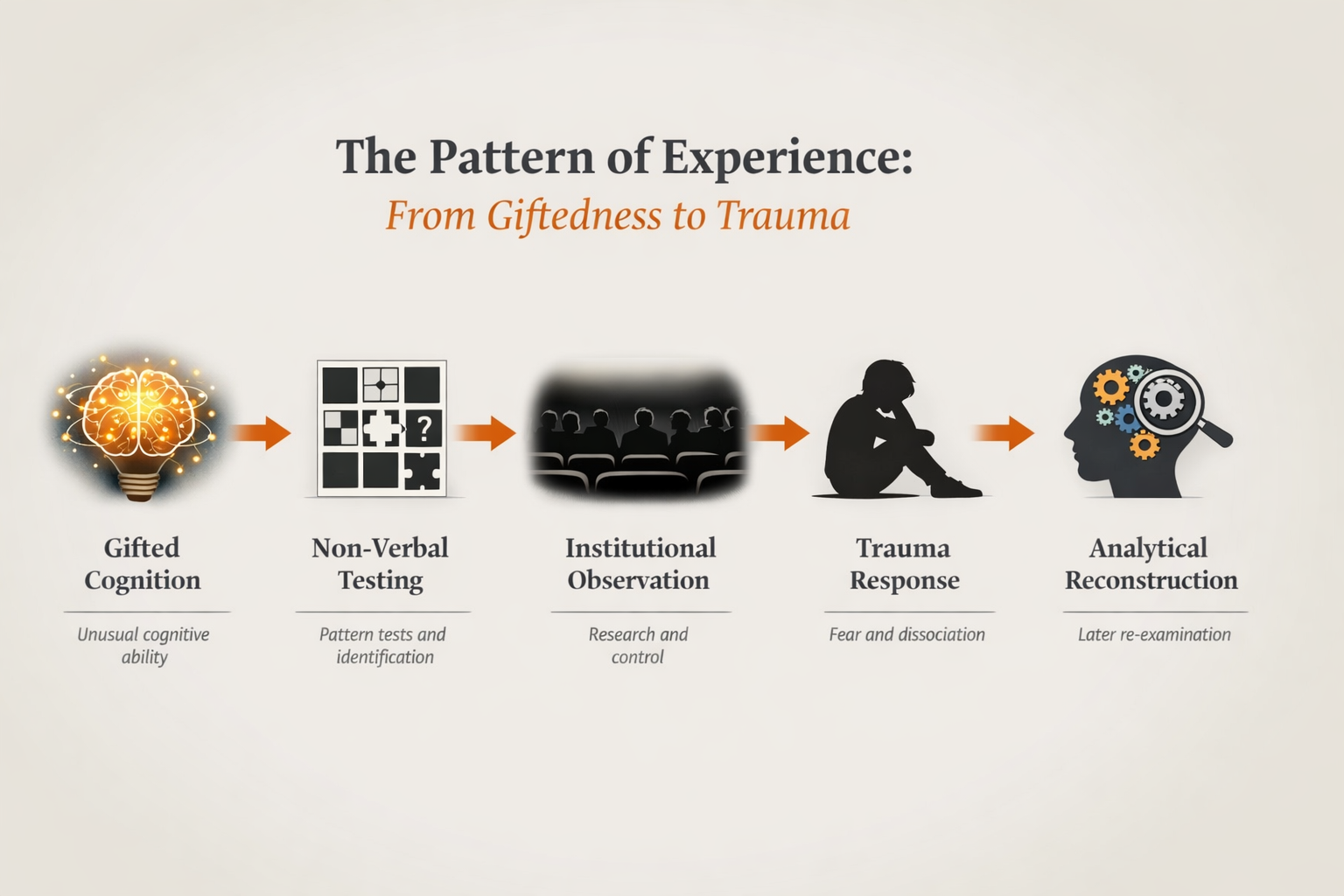
Looking back, several elements form a pattern.
Non-verbal testing identified unusual cognitive ability.
The child involved had already been living in foster care from an early age.
Professional networks connected schools, psychologists, and institutions.
And decisions about participation were made without explanation to the child involved.
The findings of the Bristol Royal Infirmary Inquiry (Kennedy Report) emphasised that institutional culture can allow professional authority to override the experiences of those most affected.
Although the inquiry focused on medical practice, its lessons apply more widely, including research environments that drew on medical or psychological methods.
When children are identified as cognitively exceptional but denied educational support, their abilities can become shaped by the environments they must navigate rather than by opportunities to develop them. Children living within institutional systems require greater protection and transparency, not less.
It is not possible to determine the precise purpose of every activity that took place in educational or observational settings during this period. Institutional records rarely capture the full experience of the children involved, and many events described by participants were not formally documented. The account presented here therefore does not attempt to assign responsibility for specific actions. Instead, it situates lived experience within the broader historical context of psychological research practices, educational assessment, and institutional decision-making in the United Kingdom during the late twentieth century.
Foster children are not research material. They are individuals whose welfare, autonomy, and development must come before institutional curiosity and the advancement of theory.
In this way, the child who was once observed becomes the one able to observe the system that surrounded them.
References
Hilgard, E. R. (1977). Divided Consciousness: Multiple Controls in Human Thought and Action. Wiley.
Kirsch, I., Capafons, A., Cardeña, E., & Amigó, S. (1999). Clinical Hypnosis and Self-Regulation: Cognitive-Behavioral Perspectives. American Psychological Association.
McCauley, M. (2022). A Century of Military Psychology in Britain and Ireland.
Naish, P. (1999). Hypnosis and Cognitive Processes. Contemporary Hypnosis, 16(3), 129–135.
Perry, B. D., & Szalavitz, M. (2017). The Boy Who Was Raised as a Dog. Basic Books.
Raven, J., Raven, J. C., & Court, J. H. (1998). Manual for Raven’s Progressive Matrices. Oxford Psychologists Press.
Silverman, L. K. (2002). Upside-Down Brilliance: The Visual-Spatial Learner. DeLeon Publishing.
Sköld, J. (2013). Historical perspectives on child abuse and neglect research. Journal of the History of Childhood and Youth.
Warm, J. S., Parasuraman, R., & Matthews, G. (2008). Vigilance Requires Hard Mental Work and Is Stressful. Human Factors.
Discover more from Society's Hidden Secrets
Subscribe to get the latest posts sent to your email.


Yes we do! Sorry for your experience, hopefully by talking about how these experiences impact us, we can create change,…